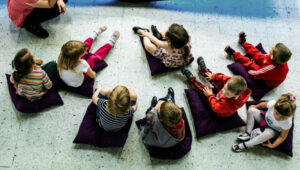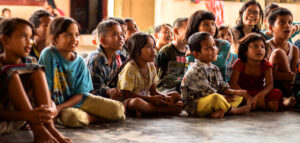
Preschool child at circle time


How do preschool teachers do it? How do they keep a group of 2-4 year olds listening and engaged at circle time?

If you’ve ever asked these questions, then you are in the right place. As a preschool teacher for over 9 years, here are some of the tricks I use for keeping preschoolers engaged at circle time.

1. Routine

Young children do better when they know what to expect. Having a regular routine helps children feel secure and confident. Building a routine for your day as well as a routine for your circle time will help this. It doesn’t need to be precisely to the minute. Focus more on the order of events. For example, nap time always follows lunchtime, or we always start our morning with five minutes of circle time and then it’s craft time.

  • Tips for building routine:
    • Think about when your children will have high or low energy. For some children, doing a high-energy activity immediately followed by a quieter sitting activity can help improve focus.
    • Use transition songs:
      • For sitting down (after standing songs or activities during circle time)
      • For the beginning and end of circle time
      • For clean-up time
      • For transitions to or from regular activities such as nap time

2. Change It Up

Once you’ve established a regular routine, consider changing minor elements of that routine to add variety. Children are naturally curious and desire to explore. Adding variety within routine helps keep preschoolers engaged and attentive. Try to balance and interchange new and challenging with familiar and comfortable.

  • You could do this by:
    • Always beginning your circle time with the same hello song, but then change up the next song every few days to keep it new and engaging.
    • If you teach about a letter every day, introduce it the same way each time, but then use a variety of ways to teach it. Here are some of the ways I like teaching the ABCs: Teaching the ABCs at Circle Time.
    • Introducing new songs. Children who attend several days a week can sing the same song every day for a few days, but then benefit from something new. Depending on your class and the time of year (children get wiggly in spring), you may find it helpful to introduce new songs more or less frequently. After a week or two, you can sprinkle in older songs every so often. My Big List of Simple Preschool Songs can help you find new songs.
    • Using a fun theme, such as one listed in this article: Exciting Preschool Themes, can help you find inspiration for new songs, crafts, activities, and stories. Once you’ve decided what your theme is, try searching Pinterest or Google for great ideas that go with your theme.
    • Find new picture books to read with your class. Your local library can help with this. I like to search for books based on the fun theme I’m using. With my two or three year old class, I might occasionally re-read a book at circle time. With a four or five year old class, I almost never re-read a book since new books tend to capture their attention better. (Yes, that means I am regularly visiting the library and returning with armloads of picture books.)
    • Tweak familiar games, activities, or crafts by changing the theme. This could be as simple as finger painting on an apple-shaped piece of paper rather than a regular paper. As for games, here is a simple game that can easily be adapted to various themes: 4 Sides.

3. Interaction: It Shouldn’t Just Be The Teacher Talking

Try to add interactive elements to your circle time so that your preschoolers can actively participate.

  • Interactive elements could include:
    • Singing action songs. These songs provide a level of interaction to circle time but don’t stop there. (Here’s a great list of action songs you could sing.)
    • Asking questions. Ideally, ask questions that every child gets an opportunity to answer. With a large group, open-ended questions may take far too long to allow the children to answer. Instead, for example, when your theme is pets, try asking each child a simple question such as, “What is your favourite type of pet?”
    • Encouraging participation. Watch how you react when a child attempts to add a comment or answers a question with the wrong answer. Your tone of voice and body language will tell the whole class whether their participation and attempts to answer even when they don’t know the correct answer are welcomed or not.
    • Using visuals. Including an activity with visuals the children can hold and touch helps keep them interested at circle time.
      • Matching – Make some matching visuals, such as my free Zoo Animal Skin Matching set. Secure one of each match on the wall or bulletin board. With the matching visuals, invite each child to come up one at a time. Hand them a visual and have them match it to the visual on the wall. Be sure that you have enough visuals for each child to have a turn. If you don’t, consider reusing some of the matches until every child has had a turn.
      • Sorting – Similar to “matching” above, have some visuals the children can hold and a background to sort them on. Invite them to come to the front one at a time. Give them a visual and encourage them to place it on the appropriate part of the background. This can work well for sorting colours, or dividing vehicles into land, air, and water vehicles.
      • Singing – I have a set of Old McDonald puppets I made from colouring pages. On days when I have enough time for every child to have a turn, I invite one child at a time to come stand with me at the front and choose one animal. They get to hold the animal while we sing that verse and then return to their spot on the carpet.

4. Keep It Short

When beginning a circle time routine, start short. Only do circle time for a few minutes at a time the first few days. Gradually, as the children get used to having circle time, you will be able to make it longer. However, be careful not to go too long. Otherwise the children will begin losing interest and you’ll have a harder time keeping them engaged.

  • A good rule of thumb is that a child will have as much attention span as their age. For example, a 3 year old will likely be able to pay attention for 3 minutes. Therefore, for 3 year olds, keep the pace of circle time fast. Don’t spend more than 3 minutes on each song, story, or most activities.

5. Alternate Between Quiet Listening, Singing While Sitting, and Standing With Big Actions

Especially if you have a wiggly class, finding excuses to have the children stand up or do full-body actions will help them be able to sit attentively for other parts of circle time. Using transition songs can be helpful when it is time to sit back down.

  • Ways to get your children standing up include:
    • Stand-up songs, such as this one: The Flamingo Song.
    • Rather than simply counting something, such as the days on the calendar, invite the children to stand up and stomp the number you are counting – one stomp for each number you say.
    • Do stretches.

6. Pay Attention: Are Your Preschoolers Engaged or Distracted or Bored?

Your children will give you cues. Each day, take time to reflect on how circle time went and how you might be able to improve it next time.

  • Are you struggling to get the children to stay sitting? You might need to find something new and exciting for circle time. Alternatively, if it is the younger children who aren’t engaged, you may need to find something simpler and more interactive for circle time.
  • Are your children goofing off when you read a book? Perhaps it’s time for a shorter and more engaging book such as one of these: 7 Fantastic Animal Guessing Books or try one of the methods in my article about Ways to Engage Preschoolers with Stories.
  • If there is another adult in the room, reflect with them on which part of circle time you seem to be losing the children’s attention. Sometimes an adult watching from the back of the room will be able to pick up on signals you might not be able to see while you are leading circle time.

7. Be Engaged

  • If you (and any other adults in the room) are interested in circle time, your children are far more likely to be interested and engaged as well.
  • Make eye contact with the children while you lead circle time.

8. Pick Your Battles

Choose carefully which behaviours you allow or disallow during circle time, especially when you are the teacher leading circle time. Every time you interrupt what you are teaching to correct a child’s behaviour, you are in danger of losing the attention of the other children.

  • Do your children really need to sit cross-legged at circle time? In some situations, yes, but in other situations, allowing them to sit with their legs stretched out in front may be just fine.
  • Is a child speaking out of turn? Glance around to see if they are distracting the other children. If not, you may be able to ignore their comments for the time being.

Mastering the art of keeping preschoolers engaged and listening at circle time is a skill that takes time to be learned. Even a teacher, who has led successful and engaging circle times for years, may find him or herself needing to step back and re-evaluate when a new class isn’t responding as expected.

So what is my final piece of advice? Take time to pause and reflect about how circle time went each day and try to think of one thing you could improve the next time around. In this way, you will develop the skill of keeping preschoolers engaged during circle time.

Need help choosing which type of seating to use for your circle time? Read 5 Types of Storytime Seating

Looking to create your own curriculum? Here’s a great place to start: Create Your Own Preschool Curriculum for Free

Gingerbread man cookies in a mug


A while back, one of my coworkers was looking for an easy gingerbread man song to sing with her preschool class at Christmas. Her search led me to come up with my own simple gingerbread man song for the holidays. Now I’m sharing it with you.

*As this is an original song, please be sure to include my name as the songwriter any time you share this song.

The Gingerbread Man Song

Words by: S. J. Little

Tune: Slippery Fish

(If you don’t know the Slippery Fish tune, I’ve included a link to it at the bottom of this page.)


Gingerbread man, gingerbread man,

You look sweet and tasty!

Gingerbread man, gingerbread man…

Yum, yum, yum…

Oh no! It’s been eaten by a cat!


Repeat the song with a different animal eating the gingerbread man.

Feel free to use just about any animal to eat the gingerbread man. Here is a list of ideas to get you started:

  • Cat
  • Dog
  • Horse
  • Fox
  • Goat
  • Owl
  • Bunny


I recommend using five gingerbread man visuals and then using a visual for each animal who is going to eat a gingerbread man.

If you don’t already have gingerbread man visuals, here’s a great free colouring sheet you could print and cut out to use:  http://www.supercoloring.com/coloring-pages/simple-gingerbread-man

Developmental Skills Practiced When Singing the Gingerbread Man Song

Counting:

If using five gingerbread men, you could start by counting how many gingerbread men you have. Sing through the song and have the “eaten” gingerbread man disappear. Then, before singing the song again, count the four gingerbread men that are left.

Depending on the developmental level and attention span of your children, you may want to use more or less gingerbread men.

Language:

The simple repetitive nature of this song helps children catch on and feel confident to sing along.

Using visuals of whatever “eats” the gingerbread man allows children to learn the names of the animals.

Social Skills:

Taking turns – try increasing the interaction with your children by letting each of them have a turn choosing which animal ate the gingerbread man.


Don’t know the Slippery Fish tune? Check out this video:  https://www.youtube.com/watch?v=aW3hNADgf-A

Looking for other original preschool songs by S. J. Little? Check out the links below.

The Flamingo Song

Shine Shine Christmas Lights

Baby Jesus, Welcome Lord

The Harvest Song


How young should we teach a child to call 911? That’s a good question. Many preschools will dedicate a week to teaching 3-4 year olds how to call 911 and other safety information they might need in case of trouble.

If you do a quick search on Google, such as “4 year old calls 911” you will likely find various news articles and recordings of humorous reasons young children have called 911 along with tales of heroic children who knew just what to do when the only adult with them passed out, such as this news clip on YouTube.

Yes, a preschooler might needlessly call 911, but they may also be in a situation one day where calling 911 saves someone’s life. With this in mind, I encourage you to teach your child how to call 911, but be sure to tell them that it is only if there is an emergency.

The following song is a great way to start teaching your child about calling 911.

If you have a different emergency number in your area, this song may still work, just switch out the number as you sing.

*As this is an original song, please be sure to include my name as the songwriter any time you share this song.

9-1-1 Song

Original song by: S. J. Little

Tune: If You’re Happy And You Know It

If you need the ambulance, call 9-1-1.

If you need the ambulance, call 9-1-1.

If you need the ambulance, if you need the ambulance,

If you need the ambulance, call 9-1-1.


If you need the police, call 9-1-1.

If you need the police, call 9-1-1.

If you need the police, if you need the police,

If you need the police, call 9-1-1.


If you need the fire truck, call 9-1-1.

If you need the fire truck, call 9-1-1.

If you need the fire truck, if you need the fire truck,

If you need the fire truck, call 9-1-1.


Actions

Every time you sing “9-1-1” hold up the correlating number of fingers – 9 fingers, then 1 finger and then 1 finger again.

If you want, find pictures of an ambulance, police car, and fire truck and point to each one as you sing about it.

Other Safety Tips to Teach Preschoolers

There are many other safety tips you can teach a preschooler. What follows are a few I recommend. If you know others, feel free to mention them in the comments section below.

  • Teach your child their own first and last name
  • Teach your child their parents’ first and last names
  • Teach your child their parents’ phone number
  • Teach your child “stranger danger”
    • If you aren’t there with them, a stranger, no matter how nice they may seem, might want to hurt them. They should never go anywhere with a stranger, unless you give them permission, even if the stranger offers candy or a chance to see puppies.
  • Teach your child who is safe
    • Explain to your child that if they ever get lost in a crowd, they should look for either someone who works there or a mom with kids as these are more likely to help them find safety. Next time you’re out at a large store or venue with your child, practice spotting employees or other safe people your child could go to if they need help.
  • Teach your child what to do in case of a fire
    • Stay low and go outside. You could even practice having a fire drill.
    • Show your child pictures of a fireman with his mask on. Teach your child that this is what a fireman might look like if he was coming to rescue them from a fire.

Let us pray that our children never need to use any of these safety tips, but, just in case, the preschool years are a good time to begin teaching these important things.

Child cutting with scissors behind title: Scissors and Preschoolers - Scissors Basics


When should children learn to use scissors? At what age are they too young? How should I teach my preschooler to use scissors?

If you’ve asked any of these questions, then you’re in the right place. As a preschool teacher who has worked closely with children, 2-5 years old, for over 9 years, I’ve learned a thing or two when it comes to teaching young children how to use scissors. In this blog post, I’m going to share what I’ve learned with you.

Why teach preschoolers how to use scissors?

If you’ve been around early learning and child care settings, you will likely have heard the term “fine motor muscles.” Fine motor muscles are the small muscles in the hands, especially those needed to hold a pencil. A child with strong fine motor muscles has a distinct advantage when it comes to learning to hold a pencil properly for writing. Therefore, we want to provide many opportunities for children to exercise their fine motor muscles. One excellent way to do so is by using scissors.

Added to that, a child who goes into Kindergarten feeling comfortable and moderately capable with scissors will have an advantage during various crafts and activities that require the use of scissors.

Which scissors to start with?

There are three basic types of scissors for preschoolers.Crayola Safety Scissors

  1. Entirely plastic safety scissors – These are the type of scissors that can cut playdough, but not much else. Most of them do not work well on paper. Crayola makes my favourite type of these scissors. They come in a set of three. I have no problem leaving these scissors freely at the playdough table for children even as young as 2 years olds. I have seen these available at various stores that also sell Crayola markers and crayons.
  2. Metal safety scissors – These scissors look like regular adult scissors except that they are smaller and have a rounded point rather than a sharp tip. These sorts of safety scissors are widely available in stores. Note that they are sharp enough to cut various materials and, therefore, require adult supervision.Maped Spring Safety Scissors
  3. Spring safety scissors – These scissors look identical to typical metal safety scissors, except for the addition of a spring. Children with weak fine motor muscles are typically able to close the scissors, but may find it difficult to reopen the scissors without using their second hand to help. Preschools often have a pair or two of these spring scissors. If you are only teaching one or two children how to use scissors, buying these special spring scissors typically is not needed. If your child struggles to open the scissors at first, don’t be worried. Simply keep practicing with the scissors and providing other fine motor exercises to strengthen their muscles.

Going forward in this article, I will be referring to the second (and/or third) type of scissors, but not the first entirely plastic ones.

When to teach preschoolers how to use scissors?

If you asked me to pinpoint an age when most children are ready to begin using scissors, I would say 2.5 years old. However, I say that cautiously. Having worked with countless children, I have noticed that some children are very impulsive and unaware of what they are doing with their hands. These children may not be ready to begin using scissors until they have matured more as scissors can be dangerous when not handled well.

Also, only bring out the scissors during calmer parts of the day. If you have multiple children around, you do not want the others running nearby while scissors are being used.

How to teach preschoolers to use scissors?

Before I tell you how to teach your preschooler to use scissors, a word of caution. Scissors are dangerous. Children, and those instructing them, must treat scissors with a degree of respect.

  • ModelYoung girl using scissors
    • If your child has never watched someone use scissors before, take a moment to grab a piece of paper and a pair of scissors and show them how to cut.
  • Thumbs up
    • Although this may feel awkward for your child at first, the proper posture when using scissors is to have thumbs up. By that, I mean that the hand holding the scissors has the thumb on the top and the fingers on the bottom when cutting. Similarly, the hand holding the paper, which I like to call the “helper hand”, should have the thumb on top of the paper and the fingers underneath. For many children, this takes practice and several gentle reminders.
  • Supervise
    • Again, scissors are dangerous – to you, your child, and to the environment around them. Be intentional to tell your child that scissors are only for paper. A child left unsupervised with scissors is prone to cutting something that shouldn’t be cut, whether the tablecloth, their clothing, the nearest ribbon, etc. This is also the age for self-haircuts. Nearly every year one of my children shows up one day with a very short haircut accompanied by their parent’s explanation that the child gave themselves a haircut. Therefore, I repeat, keep an eye on your child when they are using scissors.

Techniques for teaching children to use scissors

1. Hand-over-hand – this technique I recommend for the first few times your child uses scissors, especially if they are younger than 4 years old. For some children, only one time of hand-over-hand is needed. For other children, I would use hand-over-hand for several months before trusting them to use scissors on their own.

    • The hand-over-hand technique is exactly what it sounds like. I put my right hand over the child’s right hand and my left hand over their left hand. I find this works best if I sit on a low seat and have the child stand in front of me. In this way, I am more or less providing training wheels for the child as they learn to use scissors. While using the hand-over-hand technique, I help the children make crafts.

2. Free cutting – Some children are able to skip the hand-over-hand technique and move right to this one. Some teachers start all their children with this technique.

    • Collect a pile of papers, flyers you are planning to recycle work well. Have the child sit at a table. Give them a pair of scissors and several pieces of paper. Allow them to freely cut the paper however they wish. Many children will end up cutting the paper into itsy bitsy bits. That’s just fine. The goal of this technique is to give the children space to build the fine motor muscles needed to use scissors and to become comfortable using scissors on their own.

3. Following a line – Some children will be more engaged with their scissors if they are making something. There are various ways to give them an opportunity to do this, even when they are just starting out with scissors. I will list a few below.

Ways to incorporate scissor practice into a craft

  1. Choose a colouring sheet that matches your theme, draw a line around the image on the colouring sheet. Be sure the line is distinct from the lines of the image, perhaps by being a different colour. Have the child cut along the line. Then allow the child to colour, paint, or otherwise decorate the picture.
  2. If your craft includes several parts that you would typically cut beforehand and then give to the child to glue together, consider allowing your child to cut out one of the bigger pieces. For beginner cutters, it should be no smaller than a quarter of a sheet of paper. Once they have cut it out, have them proceed with the craft as usual.
  3. Let the child cut something to glue on. For example, if you’re talking about food, you could give your child a grocery store flyer and encourage them to cut out various food items and glue them on a piece of paper. Alternatively, let them cut a piece of paper into itsy bitsy bits and then glue the paper onto a picture to make a flower, etc.

Tips

  • Round lines are harder than straight lines
  • If your child gets distracted while holding scissors, gently remind them to look at their scissors when they are cutting.
  • Teach children that their helper hand is the one that should be turning the paper to follow the line. Their scissor hand should stay mostly straight in front of them rather than turning with the line.
  • Slightly thicker paper is often easier for children at first.
  • Teach the child, perhaps by modelling it, that when they are following a line and go off track, they need to stop and cut towards the line to get back on track.

What are some of your favourite scissor activities for your child?

Just harvested carrots and onions behind title: The Preschool Harvest Song


Ah, autumn. The time when leaves turn beautiful fall shades, children return to school, and gardens must be harvested before frost hits. It’s also the perfect time to talk about harvest with your preschoolers.

Using harvest as your preschool theme is excellent for discussing concepts such as healthy eating and for learning to categorize fruits and veggies. Not to mention all the discussion about colours and shapes that can be had.

Whether you’re using “harvest” as your fun theme or not, here’s a fantastic new song to sing with your children. I’ve been asked to sing it over and over again, and I suspect that you will be too.


Tips for singing the Preschool Harvest Song

  • Take a moment to explain what the word “harvest” means, as most children will be unfamiliar with it. I like to say that harvest is when farmers go to pick all the yummy food they grew so that people can eat it.
  • Invite your children to participate by choosing which food to sing about next. I’ve created a list of optional verses for you to choose from, but feel free to come up with more of your own. Depending on the attention span of your children, I recommend only singing 3 to 5 verses each time you sing the song.
  • Try adding visuals, whether you bring real examples of the food, make pictures of them, or cut pictures of them out of flyers. Visuals help young children understand and follow the song, especially if they are still learning English.


As this is an original song, please be sure to include my name as the songwriter any time you share this song.

Preschool Harvest Song

Song by: S. J. Little

Tune: Are You Sleeping


We are growing, we are growing,

Long orange carrots, long orange carrots.

Now we’ll harvest them to eat, now we’ll harvest them to eat.

Yummy, yummy, good! Yummy, yummy good!

Actions:

We are growing – pat field around you in several places

Long orange carrots – move fingers along outside of long carrot shape

Now we’ll harvest them to eat – start with arms wide then bring in towards self as though gathering armload

Yummy, yummy, good! – pretend to eat


Optional Verses:Hand holding freshly harvested carrots

  • Bright red tomatoes
  • Lots of potatoes
  • Juicy red apples
  • Tall yellow corn
  • Rich green spinach


What food items did you sing about with your children?

Looking for more original and engaging preschool songs? Check out the Flamingo Song and the Taxi Song both by S. J. Little.