Entering the living room with my baby in my arms, I turned to my 2 year old. “You asked if we could do a puzzle earlier, and I said not right now, but now we can do a puzzle if you want.”

My 2 year old lit up. “Okay!”

He hurried to fetch the puzzle.

I attempted to put my baby in his bouncy seat, but he fused. He was having one of those “Mommy hold me” days.

I’d just have to work on the puzzle one-handed. How hard could that be? 

My 2 year old placed the puzzle on the table and climbed onto a chair.

I helped him open the 100 piece bunny puzzle.

“Now, first we put edge pieces over here and middle pieces over there. See? This is an edge piece. It has a straight side.”

I knew the piece sorting was still a bit beyond my son’s comprehension.

My 4 year old daughter entered the kitchen.

I smiled at her. “Want to help us with the puzzle?”

She frowned. “No… Well, just for the sorting.”

With my daughter’s help, we soon had the pieces sorted. 

She wandered off to the living room.

I shifted my baby to the other arm.

My son was trying to put two totally unrelated pieces together.

I knew I had to act fast before he became too discouraged. 

I sifted through the edge pieces finding several for the grass at the bottom of the puzzle.

I spotted two that should fit. I put them together. Good.

Taking the pieces apart, I passed them to my son.

“Here. These two go together.”

As he turned his attention to them, I slid the mismatched pieces away from him.

It only took him a moment to connect the two pieces I had passed to him.

He reached for the closest piece and began trying to make it fit.

I turned my attention back to my pile of pieces.

Finding another that would fit with his pieces, I passed it to him.

While he worked to attach that one, I strained my brain to line up five more pieces. Rather than connect the pieces, I slide them in front of him.

“Here. Put these ones together.”

I paused to stretch, then was back at it.

It took a lot of quick thinking to keep my son supplied with connecting puzzle pieces.

As we neared the end of the puzzle, my daughter came to help us finish.

By the end of the puzzle, my brain felt fried, but I had a happy 2 year old and a completed puzzle.

Later, I paused to reflect on how much work it was for me to put together 100 perfectly fitting pieces.

How much greater is God who is piecing together all of history!

God is orchestrating all things into a cohesive, marvelous big picture story, even while giving me free will to make choices.

As Paul taught in Acts 17:24-27:

“The God who made the world and everything in it—He is Lord of heaven and earth… He Himself gives everyone life and breath and all things. From one man He has made every nationality to live over the whole earth and has determined their appointed times and the boundaries of where they live. He did this so that they might seek God…” (CSB)

When I read the whole Bible from cover to cover, this becomes more apparent.

What a beautifully intricate and incomprehensibly complex puzzle God has woven together, and He doesn’t feel worn out from this work (unlike me with a measly 100 piece puzzle).

What an incredible God we serve!

In the midst of that, I get to be a part of helping put the pieces together as I make choices day by day.

Sometimes, like my 2 year old, I try to put the pieces together the way I want.

I grab two totally unrelated pieces and try to force them into place.

I don’t know they don’t belong together in the big picture, but God knows.

As I submit to His guidance in my life, God passes me puzzle pieces that do belong together.

I get to partner with God in putting them together, though in truth, He is the mastermind behind it all.

He shows me what role He wants me to play. I am simply to obey.

Whether that is inviting a neighbor to church, writing a blog post, praying for a co-worker, volunteering at church, or helping a friend in need. It is also in the bigger choices I make: who I marry, where I live, what job I do.

As I ask Him to guide me in these things, I join Him in building a part the big picture story.

How incredible that God, the Master Puzzle Maker, invites me into the process of helping put the pieces together!

May I be faithful to follow His instructions.


Add A Little – 4 Year Old Curriculum – Unit 2

Healthy Eating

Disclaimer: All activities require adult supervision and discretion. Read more...

Want to learn more about Add A Little Curriculum? Check out the Parent / Teacher Guide

Ready, Set, Move

I’m Hungry For…

Academic Focus: ABCs

Supplies:

  • One puppet or stuffed animal
  • Use the pieces from an alphabet puzzle
  • Alternatively use:
    • Paper
    • Marker
    • Scissors

Prep:

  • If not using an alphabet puzzle, cut a sheet of paper into 2″ (5cm) pieces. Write one letter on each paper.
  • Clear a space for active play.

Time to Play:

  • Show your children the letters, then place the letters at one side of the room.
  • Sit with the puppet at the other side of the room.
  • Have the puppet say something along the lines of: “Hi! My name is Harry. It’s nice to meet you. Oh, I’m really hungry. I’m especially hungry for the letter ‘A’.”
  • Ask a specific child to find letter “A” and give it to the puppet.
  • Have the puppet pretend to eat the letter and say thank you.
  • Have the puppet say something like: “That was delicious! But I’m hungry again. This time what I really want to eat is letter ‘G’.”
  • Continue until all the letters have been fed to the puppet.


Explore, Learn, Create

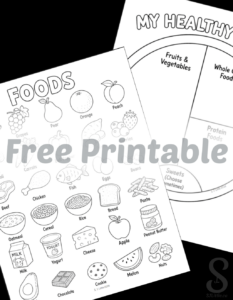
Healthy Eating Plate

Supplies:

  • Print one serving plate per child or draw your own
  • Either use grocery store flyers
  • Or print the foods colouring sheet. Print enough for every child to have at least a quarter page.
  • Child safe scissors
  • Glue stick

Prep:

  • Print the needed papers (or collect your own resources)
  • Note, the food groups shown on the plate are based on Canada’s Food Guide (2026). This guide classes meats, meat alternatives (nuts and beans, etc.), and dairy as “Protein Foods”. I added a small “Sweets” section to help teach that some sweets are fine, but the majority of our food should be in the other food groups.

Time to Create:

  • Show your child the plate. Read the labels on each section.
  • Explain to your child that it is healthy to have foods in those proportions.
  • Give your child a flyer or the foods print out and a pair of child safe scissors. Encourage them to cut out various food items.
  • Next, help your child sort the foods into the different sections of the plate.
  • Give your child the glue stick to glue the foods onto the plate.

Let’s Sing

Preschool Harvest Song
An S. J. Little original

For lyrics and actions, click here.

Let your children take turns choosing which fruit or vegetable to sing about and this song will quickly become a favorite.

Let’s Read

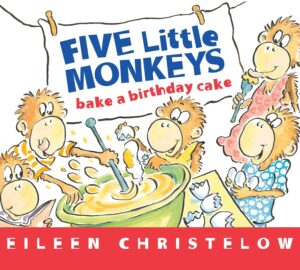
Five Little Monkeys Bake a Birthday Cake

By Eileen Christelow

Let’s Sing

Christian Song

Fruit of the Spirit (Galatians 5:22-25)

Let’s Read

BIBLE

Read the next story in the picture Bible you are working your way through.
 

“Draw. Draw.” My toddler begged.

I reached for the crayons. “Okay, we can do some colouring.”

She helped me get some paper and our mini colouring table.

I passed her the open crayon box. She took a blue crayon out, then handed a green one to me.

“This one is for me?”

She pointed to one of the papers. “Mama draw.”

“Okay. Hmm… What should I draw? I know. I will draw a circle.”

As she scribbled on the page, I drew a circle. I added two eyes, a triangle nose, and a mouth to the circle.

“Look, I drew a cat.”

“Kitty! Ear.” She reached over and scribbled blue where the cat’s ear should be.

“Thanks for giving my cat an ear.”

Taking the crayon box, she exchanged her blue for a different crayon. This crayon was orange, but when she pulled it out, she noticed something.

“Broken.” For a moment she looked about to cry.

“That’s okay,” I tried to reassure her. “You can still colour with it.”

She stared at the two pieces of crayon in her hand, then tried to put them back together. It, of course, didn’t work.

She turned to me confidently. “Dada fix it.”

I was tempted to laugh, but her little face was so serious and confident.

“Maybe Dada will fix it. You can ask him when he comes home.”

She nodded and repeated her words. “Dada fix it.”

Setting aside one of the pieces, she happily returned to her colouring with the other broken piece.

This was only one example of the many times I have heard those words uttered from her lips with complete confidence.

“Dada fix it.”

When she saw a ripped book, she was concerned, but then told herself, “Dada fix it.”

When she saw an upholstered chair that had long ago been shredded by cat claws so that it now was adorned by a blanket. She was sad, but then decided. “Dada fix it.”

The faith my little girl has in her daddy’s ability to fix things has shown up many times.

Sometimes my husband does indeed fix whatever it was that was broken. Other times he does not. Yet still she remains confident of his ability to fix anything.

What about me? Do I believe that my Heavenly Father can do anything?

Do I really believe what Mark 10:27 tells us?

“Looking at them, Jesus said, ‘With man it is impossible, but not with God, because all things are possible with God.'” (CSB)

Now just because God can do anything doesn’t mean that He will.

Yes, my husband could technically fix the broken crayon. He could melt the two pieces and reform them into a whole new crayon. Did he choose to do this? No. Instead, we taught our little girl to be content to work with what she has. Broken crayons still colour just fine. Indeed, a few months later, she often sought out that broken crayon as one of her favourites to colour with.

Philippians 4:6 says, “Don’t worry about anything, but in everything, through prayer and petition with thanksgiving, present your requests to God.” (CSB)

God can do anything, and He wants us to bring our requests to Him.

He will not always do what we ask or want, yet He still wants us to ask Him, even if the thing seems too small to bother or too impossible.

Nothing is too impossible for God.

Today, may I truly believe that God can do the impossible, and may I bring my requests to Him.

As I do so, Philippians 4:7 will become mine. (I’ve included verses 4-7 for fuller context.)

4Rejoice in the Lord always. I will say it again: Rejoice! 5Let your graciousness be known to everyone. The Lord is near. 6Don’t worry about anything, but in everything, through prayer and petition with thanksgiving, present your requests to God. 7And the peace of God, which surpasses all understanding, will guard your hearts and minds in Christ Jesus. (Philippians 4:4-7 CSB)


Add A Little – 4 Year Old Curriculum – Unit 1

Four Seasons

Disclaimer: All activities require adult supervision and discretion. Read more...

Want to learn more about Add A Little Curriculum? Check out the Parent / Teacher Guide

Ready, Set, Move

Spring’s Coming

Prep:

  • Clear a large area for active play
  • For your own reference, write down which commands you will use. Have a few extra at the bottom of the list in case your children need an added challenge. Options include:
    • Spring – pretend to grow like a flower: crouch low and move your arms upwards until you are standing tall. Spread your arms wide like a flower.
    • Summer – pretend to go swimming to cool off
    • Fall – pretend your hands are leaves: reach up high with your hands, then have them float gently to the ground.
    • Winter – pretend to put on winter clothing – snow pants, boots, coat, toque, mittens.
    • Could add directions: run to North, East, South, or West. (These would be easier to remember if you put up letter posters for each side. Keep each direction on its true compass direction since your children may use these as a reference point in the future.
  • For an added challenge, could use partner actions that involve two children or all the children.
  • Optional: Consider making visual cues for each action. For example, hold a yellow object for summer, orange for autumn, white for winter, and green for spring.

Time to Play:

  • Gather your children and explain that you are going to play “Spring’s Coming”. They will walk around the area until you call a command. When you call that command, they stop and do the action wherever they happen to be standing.
  • Show them two or three actions to begin with.
  • Play with those actions until your children get the hang of it, then you can add in more actions one or two at a time.
  • Have fun and smile. Participate with your children by doing the actions too.

Explore, Learn, Create

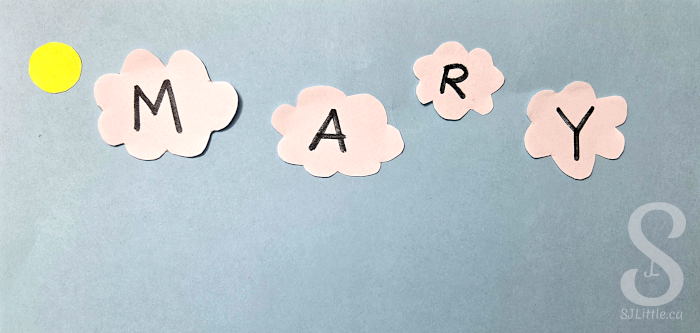
Cloud Names

Academic Focus: Name Writing

Supplies:

  • White paper
  • 1 blue paper per child
  • Optional: yellow paper (to make a sun)
  • Crayons to decorate with
  • Child-safe scissors
  • Glue stick (or tape)

Prep:

  • On the white paper, draw enough cloud shapes to have one cloud shape per letter of each child’s name.
  • Decide whether you will cut out the cloud shapes or have your child cut them out. If you will cut them out, do that now.
  • Consider making a sample picture with your name to show your children.

Time to Create:

  • If you made one, show your child the example picture, if not, show them the supplies. Explain that they are going to write their name on the clouds.
  • Have your child cut out the clouds, unless you already cut them out.
  • Help your child line up the correct number of clouds for the letters in their name.
  • Encourage your child write one letter of their name on each cloud.
  • Name Writing Tip: If needed, use a yellow marker to write your child’s letters for them, then give your child a dark coloured crayon to trace over top. Be encouraging. It won’t be prefect. (Emphasize how they draw the letters, i.e. starting at the top and the order of which part of the letter to draw first. Don’t worry about proper grasp yet.)
  • Help your child glue the clouds on the blue paper in order.
  • Optional: Decorate the picture by adding a sun or drawing rain, etc.

Let’s Sing

What’s the Weather

Let’s Read

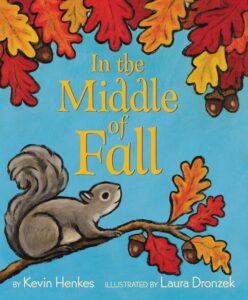
In the Middle of Fall

Author: Kevin Henkes
Illustrator: Laura Dronzek

Check out their books about other seasons as well.

Let’s Sing

Christian Song

Seasons for Us: God Made It So

Let’s Read

BIBLE

Read the next story in the picture Bible you are working your way through.
 

Add A Little – 4 Year Old Curriculum – Intro

Parent / Teacher Guide


Intro

Why name a curriculum “Add A Little”? Because that’s exactly what this curriculum is designed to do – add a little enhancement to your child’s development. Through games, crafts, activities, books, and songs, AAL inspires a love of learning. This light curriculum was developed with the busy parent or caretaker in mind.


Academic Focus for 4 Year Olds

Generally speaking, Kindergarten begins at age 5. That means 4 year olds are in their final year of preparing for Kindergarten. With that in mind, the Add A Little Curriculum (AAL) for 4 year olds includes an intentional, but gentle, focus on four areas of preparation for Kindergarten: Alphabet, Numbers, Fine Motor Skills, and Broad Knowledge. In every unit, either the “Ready, Set, Move” activity or the “Explore, Learn, Create” craft will have a strong academic focus touching on these areas.

Want to know more about preparing for Kindergarten? Check out: https://sjlittle.ca/preschool/ready-for-kindergarten-academically/

Don’t forget to read the Tips for Success below.


Table of Contents

Each Unit Includes:

  • Theme
  • Ready, Set, Move       
  • Explore, Learn, Create
  • Let’s Sing
  • Let’s Read
  • Let’s Sing a Christian Song
  • Let’s Read the Bible

Units

Tips for Success When Using Add A Little Curriculum

Disclaimer

Helpful Links

Each Unit Includes:

Theme

Every unit has an engaging theme selected specifically for 4 year olds. These themes aim to introduce more advanced topics to capture your child’s interest.


Ready, Set, Move

Physical exercise plays a vital role in healthy brain development. That’s why every unit includes a game to get kids up and moving.


Explore, Learn, Create

Not only are crafts engaging for most preschoolers, these activities are also a fantastic way to develop the fine motor skills needed for writing with proper pencil grasp. (Do not be concerned if their pencil grasp is not proper yet. That will likely come naturally as their fine motor muscles development and when they use short pencils.)


Let’s Sing

Preschool action songs are not only fun, they are valuable for developing language skills, vestibular sense, and proprioception. Many of the songs used in AAL also have educational elements making learning fun.

Want more song ideas? Check out this list of Simple Preschool Songs: https://sjlittle.ca/preschool/big-list-of-simple-preschool-songs/


Let’s Read

If you want your child to love reading later, teach them to love books now. Reading together grows vocabulary and broad knowledge. It also gives an excellent opportunity for gently introducing science and social skills. Regardless of whether you read the exact books recommended in each unit or not, making the time to regularly read high quality books with your child will reap huge rewards.

Pinterest links:


Let’s Sing a Christian Song

Beyond all the general benefits of singing, Christian songs instill timeless truths in your child’s heart.

Want more Christian songs? Visit: https://sjlittle.ca/preschool/7-simple-christian-songs-for-preschoolers/


Let’s Read the Bible

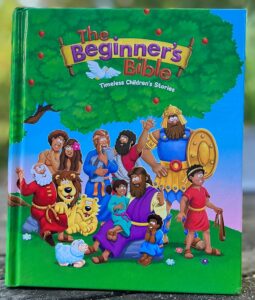
4 year olds are ready for regular children’s Bible reading. There will not be specific Bible stories suggested with each unit. Instead, pick up “The Beginner’s Bible” and make a habit of reading one story per day, or one story per week, and read your way through the whole Bible.

For more information visit: https://www.thebeginnersbible.com/products/

Units

Every month, one new unit is released. Here is a list of units that have already been released:

Unit 1: Four Seasons


Tips for Success When Using Add A Little Curriculum

  • Writing Their Own Name: While learning to write the ABCs is generally considered a kindergarten skill, learning to write one’s own name is a great skill for 4 year olds. One simple way to practice is to make a habit of having your child write their name on the back of every craft they do. Don’t expect perfection. Don’t worry about pencil grasp yet. Keep it fun. Their skill will slowly improve.
  • Engage: Engage with your children. Be interested and involved in the learning fun.
  • Adapt: Read the lesson ahead of time and be prepared to adapt. Units don’t have to be followed exactly.
  • Teach the Next Thing: Watch what your child is capable of doing independently, then teach them how to do the next thing. Can they count to 10? Good, now teach them to count to 12.
  • Read: Search the unit theme at your local library to find more books you can borrow for low cost. Then read, read, read to your kids. A love of books is foundational for learning to love reading by themselves.

Want More?

Do you want to receive notification of each new unit of the Add A Little 4 Year Old Curriculum when it is released? Join S. J. Little’s preschool email list today.


Disclaimer

All activities require adult supervision and discretion.

Every aspect of the Add A Little Curriculum is suggested with the expectation that it will be done under adult supervision. Some activities include potential hazards. You and your child(ren) participate at your own discretion.

Every child, family, setting, and circumstance is different. Recommended tips and/or activities in this curriculum may work well for some children but not for others. Adult discretion is required. In some cases, you will need to adapt the curriculum to fit you and your child(ren)’s specific needs.