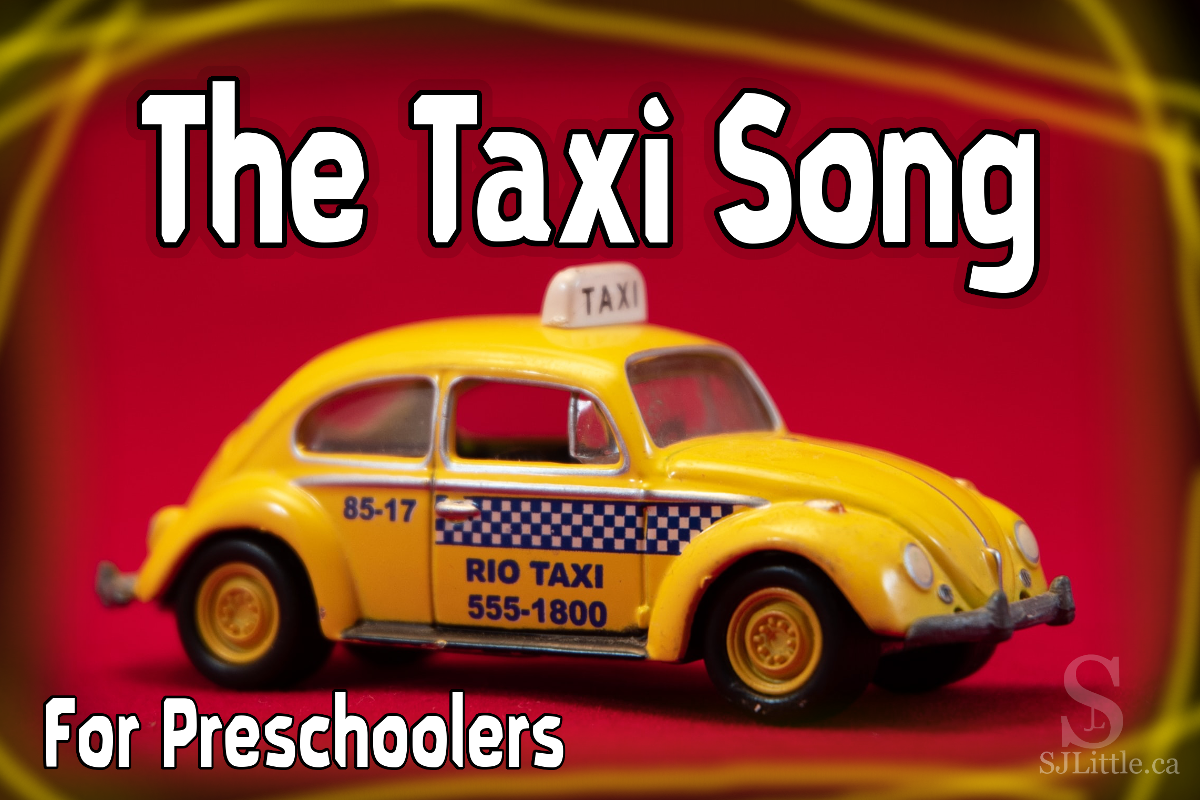
Toy taxi with title: The Taxi Song

Have you ever focused on taxis as your preschool theme? Perhaps you focused on cab drivers as part of your theme of community helpers, or occupations? Or maybe it was a book that spurred your child’s interest in taxis. Regardless of the reason, it can be tricky to find good songs on this topic. That’s why I created this new preschool song about taxis.


Tips for singing the Taxi Song

I like to start this song by pretending to look for a taxi, then pointing and exclaiming, “I see a taxi!” At this point, I launch into the song. After singing the song once, I will pause and say, “I think we should go somewhere else now. I know, let’s go to the airport. That means we need to look for another taxi. Oh, there one is!”

Depending on your children’s age and the size of your group, you may be able to let your children choose the destinations.

*As this is an original song, please be sure to include my name as the songwriter any time you share this song.

The Taxi Song

By: S. J. Little

Tune: The Wheels on the Bus


Taxi, taxi, wait for me, wait for me, wait for me.

Taxi, taxi, wait for me. I need to go to town.


Variations

“Town” can be changed to other destinations based on your children’s interests.

My favourite destinations include:

Other destinations could be:

  • The hospital
  • Downtown
  • Market
  • School
  • The Playground


Actions

The actions for the taxi song are simple and fun.

  • Taxi, taxi, wait for me – wave your arms above your head as though trying to catch the attention of a taxi driver
  • I need to go to town – point to self, then point in the direction of “town”

Other original preschool songs by S. J. Little

If you liked this song, don’t forget to check out my other original songs, including:

Flamingos behind the title: Flamingo Preschool Song


Not long ago, I created this brand new preschool song. It fits well with themes such as: Summer, Birds, Zoo, and Pink. The actions include standing on one foot which is a valuable skill for preschoolers to practice as they strengthen their gross motor muscles.

Did you know?

  • Flamingos sleep while standing on one leg.
  • Flamingos get their pink colour from their diet of shrimp and algae.

As this is an original song, please be sure to include my name as the songwriter any time you share this song.

The Flamingo Song

Words by: S. J. Little

Tune: Are You Sleeping


Flamingos flapping, flamingos flapping,​

Big pink wings, big pink wings.

Flying through the sky, flying through the sky.

Time to land! Time to land!


Flamingos standing, flamingos standing,

On one foot, on one foot,

Sleeping while they’re standing, sleeping while they’re standing,

Time to wake! Time to wake!

Actions

  • Flamingos flapping – flap your arms
  • Big pink wings – flap your arms bigger
  • Flying through the sky – tilt your body while flapping your arms to suggest soaring through the sky
  • Time to land! – Stomp and emphasize the word “land”


  • Flamingos standing – stand on one foot
  • On one foot – stand on one foot and hold up one finger
  • Sleeping while they’re standing – pretend to sleep while still standing on one foot
  • Time to wake! – startle awake and emphasize the word “wake”

I hope you and your children enjoy this original flamingo song. If you do, don’t forget to join my email list to stay tuned for more unique preschool songs.

Looking for more animal songs? Check out If You Want To Be A… (Preschool Animal Song)

A preschooler reading a book


I have collected a list of books that teach preschoolers they’re special because I know children face incredible pressure from all sides. Some types of pressure encourage them to grow and thrive, but other types of pressure urge them to try to be like someone else. These stories remind preschoolers that they don’t need to change who they are. They are special just the way they were made.

3 Books to Teach Preschoolers They’re Special

Still A Gorilla by Kim Norman

Still A Gorilla

Written by Kim Norman, Illustrated by Chad Geran

Not only does this story have an important lesson, it’s fun and engaging too. My children loved answering my questions along the way. “Does he look like a walrus?” “Do you think he makes a good crocodile?” Your children will doubtless enjoy the author and illustrator’s humorous portrayal of the gorilla’s attempts to be like the other animals at the zoo.

Elephants Can't Jump by Jeanne WillisElephants Can’t Jump

Written by Jeanne Willis, Illustrated by Adrian Reynolds

Did you know elephants can’t jump? In this picture book, the elephant longs to be able to join in his friends’ fun, but he can’t. Why? Because elephants can’t jump. His friends make fun of him until one day his natural elephant strength saves them all from trouble.

The Mixed-Up Chameleon by Eric CarleThe Mixed-Up Chameleon

Written and Illustrated by Eric Carle

When the chameleon visits a zoo, he finds himself longing for the strengths of each animal he sees. His wish comes true! He gets flamingo wings, a giraffe neck, a turtle shell, and much more. Eventually, he starts getting hungry. A fly comes by. The chameleon tries to catch it, but finds that he has gotten so mixed up wishing to be like all the other animals that he can no longer do what he used to be so good at – catch flies.


Have Older Children?

Check out:

I Wish That I Had Duck Feet by Dr. SeussI Wish I Had Duck Feet Written by Dr. Seuss, Illustrated by B. Tobey

Or for a Christian book:

You Are Special by Max LucadoYou are Special Written by Max Lucado, Illustrated by Sergio Martinez


What other books do you know that help teach preschoolers that they don’t need to try to be like someone else – they’re special just the way they were made?

Looking for more great books for your preschooler? Check out these 7 Fantastic Animal Guessing Books for Preschoolers

Children jumping and title "3 No-Prep Outdoor Game to Play with Your Preschooler"


As the weather gets warmer, it’s valuable to get kids outside and moving. That’s what these classic 3 games are all about. Best of all, they are no-prep outdoor games so you can play them just about any time and anywhere.

You may already be familiar with some of these games. Perhaps you played them as a child. I know I did. Whatever the case, if you’re looking for more games to play with your preschooler, keep reading.

Tips for No-Prep Outdoor Games

Before we get into the games themselves, I have a few tips for you.

  • Keep a close eye on the children’s interest level. Try to end the game just before the children begin feeling bored. This way, they will remember it as a fun game. If you wait until they are extremely tired and bored, they are less likely to enjoy the game again in the future.
  • Choose a playing space based on the age and stamina of your children. For older children choose a larger playing area, for younger children, a smaller space will do. You could use a field, your backyard, a multipurpose room, or a patio (with good railings). Get creative.
  • Have fun! If you are enjoying the game your child is far more likely to have fun playing.

What Time is it, Mr. Wolf

Even if you don’t know this game, there’s a good chance your children might. This game can be used in a variety of settings, including swimming lessons and skating lessons.

Number of Children:

  • Large group
  • Small group
  • One-on-one with an adult

Child Development:

  • Counting
  • Gross motor movements (running and stepping)
  • Turn-taking (waiting for their turn to be the wolf)
  • Following instructions

How to Play:

Select one person to be the “wolf”. Have them stand on the opposite side of the playing space. Have the other players line up side by side on the starting line.

Together, all the players (except the wolf) call, “What time is it, Mr. Wolf?”

The wolf calls back a number between 1 and 12, or “Lunchtime!”

If the wolf says, “It’s 3 o’clock,” all the players take three steps toward the wolf.

Then all the players ask again, “What time is it, Mr. Wolf?”

Whenever the wolf chooses, he can reply, “Lunchtime!” When he does, the wolf chases all the players back to the starting line.

If the wolf tags anyone before they reach the starting line, they become the wolf. For small groups of 8 children or less, just the person who was tagged first becomes the wolf and the first wolf becomes a player. For larger groups, every child who is tagged joins the wolf so that, as the game progresses, there are more and more wolves and less players.

For older children, have the wolf turn around so that they cannot see how close the players are getting. This is not necessary for preschool children and it can be tricky to keep them from peeking.

Red Light, Green Light

Fantastic for use while teaching transportation or safety themes, this game is well-loved and for good reason. While this game absolutely works without any prep, it can be improved by choosing something to use as the “red light” and the “green light”. In the past, I have used printed stop and go signs, blank red and green pieces of construction paper, red and green hula hoops, red and green cones, or whatever else I had on hand.

Number of Children:

  • Large group
  • Small group
  • One-on-one with an adult

Child Development:

  • Gross motor movements (running and stopping)
  • Ear-body coordination (hearing instructions and obeying them)
  • Listening skills (learning to respond to “stop” or “red light”)

How to Play:

Choose who will be the “caller”. The caller can be a child or a teacher/parent. Have the caller stand on one side of the playing space. Have all the children stand side by side on the opposite side of the playing area. 

When the caller says, “Green light!” all the players run toward the caller. When the caller says, “Red light!” all players must stop where they are. The caller continues to call “red light” and “green light” until all the players reach where the caller is standing. Then a new caller is selected and all the players return to the opposite side of the area.

For 8 or fewer children, allowing the children to be the caller works well. For bigger groups of preschool children, it may be best to only have the teacher be the caller. This is especially helpful if you are under tight time constraints. When the teacher is the caller they can control the game. For example, they can make it shorter if gym time is almost over.

For elementary aged children, this game becomes a challenge to not be caught moving when it’s a red light. If caught moving, they are sent back to the start line. For preschool children, remembering to follow the instructions is often exciting and engaging without being sent back to the beginning. However, if a child really isn’t responding to the red light, sending them back to the starting line will help them be more intentional to pay attention next time.

Extend the Fun:

  • Extend the fun by adding more colours. This works especially well if you have visuals to hold up for each colour. Some ideas include:
    • Orange = go slow
    • Blue = (stop and) turn around
    • Purple = hop
  • Are you doing a transportation or safety theme? Try making visuals representing the stop and walk crosswalk signals to help children learn what they mean.

Mother May I

I recommend this game for a small group of 3-5 children who are aged 3-5. This is due to how slow the game can be when each child moves separately. For larger groups, try having all the children take the steps together, much like What Time is it Mr. Wolf.

As an adult, this game may seem pointless, but many children love it. They enjoy having the power to make choices when they are the “mother”. Be careful to ensure that every child has a turn to be the mother.

If you are uncertain about using this game’s traditional name “Mother May I” try calling it something like “Monkey May I”.

Number of Children:

  • Small group

Child Development:

  • Variety of gross motor movements (large steps/small steps, and if extending the play: jumps and turns)
  • Turn-taking (waiting for their turn to ask to move and to be the mother)
  • Making choices (preschoolers love being able to choose and that’s why this game holds appeal for them)
  • Counting
  • Following instructions (if extending the play, following 2-step directions)
  • Good manners

How to Play:

Select one child to be the mother. The rest of the children line up on one side of the playing space while the mother stands on the opposite side.

For this game, each child has a turn to ask the mother what number of steps they can take. Typically, I limit the number to anything between 1-12. Have the first child ask, “Mother, may I take 3 steps?”

The mother gets to choose. They can say, “You may,” at which point the child who asked moves the prescribed number of steps. Alternatively, the mother can say, “No.” If the mother says, “No,” she must then tell the child how many steps they may take, for example, “You may take 2 steps.” The child who asked will then take only 2 steps forward.

Following that, it is the next child’s turn. Continue giving the children turns. The game ends when a child reaches the mother. Then choose another mother and have all the children go back to the starting line.

Again, I stress that when playing this game, it is very important to give every child a turn being the mother.

Extend the Fun:

Once the children have played several rounds, change things up by describing the type of step. “Mother, may I take 1 giant leap?” “Mother, may I take 12 tip-toe steps?”

Ideas include:

  • Tiny steps
  • Giant steps
  • Small hops
  • Big jumps
  • Backwards steps
  • Tip-toe steps

Final ThoughtsGirl running outside

Do you have older kids? For groups of children aged 4-10 I recommend the game: Farmer Farmer. It is similar to British Bulldog, but with a twist. 

What other no-prep outdoor games do you enjoy playing with your preschoolers?

Do your preschoolers still have energy? Great! Here are two other ideas to help you keep them moving:


Looking for a game to play with your preschooler? Here’s a new one for you to print and enjoy together.

Are you familiar with the classic game Snakes and Ladders? If so, you are well on your way to knowing how to play this game. The primary difference is that, for this game, rather than having snakes and ladders, if a player lands on a yellow framed square, they move to the matching rhyme square. Confused? Don’t worry, I’ll explain.

What You Need

  • The ABC Rhyming Snakes and Ladders Game board printed out
    • Alternatively, open the image on a tablet or iPad and use that as your game board.
  • 1 six-sided die
  • 1 playing piece per person – I encourage you to use plastic pawns from a board game. Alternatively use very small toys, buttons, or even coins. (Beware of choking hazards.)

How to Play

  • Place everyone’s playing piece on the “START” square.

    Direction of play on the game board
  • Have the first person roll the die and move their playing piece accordingly.
    • For example, if they roll “4”, have the person move their playing piece to the fourth square which has the pig on it.
  • Players take turns rolling the die and moving their playing piece to the appropriate square.
    • Further details: Once everyone has had a turn to roll and move their playing piece, the first person gets to roll again. If the first person rolls a “5” on their second turn, they will continue counting from the fourth square with the pig on it until they reach the umbrella.
  • If a player lands on a square with a yellow frame around it, such as the boat, they move to the matching rhyme, in this case, the goat. Only squares with yellow frames have matching rhymes. The player moves to the corresponding rhyme regardless of whether they are moving forwards or backwards. (These moves are equivalent to snakes and ladders.)
  • The goal of the game is to reach the “FINISH” square first.

Educational Elements in ABC Rhyming Snakes and Ladders

Rhyming Matches
  • Rhyming – Listening to the distinct sounds in each word is a challenging skill for many children. It is also an important pre-reading skill. When playing this game with your child keep in mind that learning to rhyme is difficult for a 3 year old and may still be challenging for a 4-5 year old if they have not yet been taught about rhymes. Have patience as you model and teach the skill. Say the words slowly and emphasize the rhyming sounds. Once your child has a handle on rhyming, learning to read will be a little easier.
  • ABC Order – You may have noticed that the letters on this game board are not in alphabetical order. This is intentional. Children are incredibly smart. It is not uncommon for a child to memorize the letters in alphabetical order rather than learning to distinguish each letter by shape.  Mixing up the order of the letters gives an extra challenge and a chance for the parent to see how many letters their child can recognize by sight. I encourage you to take a moment to look at the letters on the board together.
  • Pictures – I have included a picture for each letter. These pictures serve as reminders for the child of what sound the letter makes. Sound out the name of the picture with your child to help them distinguish the sound of the letter at the beginning of the word. Grasping that each letter makes a sound and that those sounds can be combined into words will go a long way in preparing your child to start reading.
  • Counting / Turn-Taking / Waiting – These are three of the hidden developmental bonuses of playing a game like this. Every time your child rolls the die and moves their playing piece, they are practicing counting. Every time they have to wait for their turn, they are sharpening valuable social skills.

Like this free resource? Be sure to tell your friends about it and join my email list for access to other free printables.