
Are you teaching about community helpers, such as mechanics, or is your theme transportation? Is your child simply excited about cars? If you answered yes to any of these questions then you’ll want to check out the preschool fingerplay below.

The Three Little Blue Cars fingerplay promotes learning to count to three, problem-solving, and builds vocabulary.

Three Little Blue Cars

Original words by S. J. Little

Tune/rhythm: Five Little Monkeys Jumping on the Bed


Three little blue cars driving down the road,

One popped a tire and could not go.

“Oh no!” said the driver. “What shall we do?”

“Call the mechanic to make you good as new.”


Two little blue cars driving down the road,

One hit a big tree and crushed his bumper.

“Oh no!” said the driver. “What shall we do?”

“Call the mechanic to make you good as new.”


One little blue car driving down the road,

He blew his engine and smoke billowed out.

“Oh no!” said the driver. “What shall we do?”

“Call the mechanic to make you good as new.”

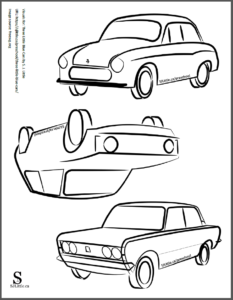
This fingerplay lends itself well to visuals. Therefore, I put together a free printout for you. I recommend either printing it on blue paper or colouring the cars blue after you have printed them out.

Three Blue Cars Visual – Free Download


Have fun sharing this fingerplay with your little one!

Interested in more preschool transportation songs?

Take a look at the 9-1-1 Song, and the Taxi Song.

A child and many toys behind the title: 3 Cleanup Strategies


Do you have young children? Have you ever struggled to get them to help clean up? If so, you are certainly not alone. First off, children must learn the skill of cleaning up as most of us are not born with it. Secondly, it can be challenging to motivate a child to clean up, especially when they want to keep playing.

To help you out, I’ve collected three cleanup strategies for toddlers and preschoolers as well as a handy list of tips.

3 Cleanup Strategies

  1. Sing a Cleanup Song

  • Using a cleanup song can be a great strategy for helping young children know it is time to switch gears from playing to cleaning up. There are many different cleanup songs you can find online. Feel free to spend some time searching for one you like.
  • Here is a classic cleanup song you may already be familiar with. As far as I can tell, this song originally came from the Barney TV show. The words are simple and you can sing it as many times as needed.
    • Clean up, clean up, everybody everywhere,
    • Clean up, clean up, everybody do your share.

  2. “Who Can Clean Up the Fastest?” Game

  • Some children are competitive. This can be used to your advantage. Try making cleanup time a competition. The competition could be:
    • Between two children: “Sam, you clean this side of the room, and, Jane, you clean that side and let’s see who can get their side cleaned up first.”
    • Between a child and yourself: “Let’s see if you can clean up the cars before I finish cleaning up the paints.”
    • Between a child and a timer: “I’m going to start the five minute timer. See if you can clean up this whole room before it goes off.”
    • Between the child and themselves (for older children): “Last time you cleaned up all the blocks in 1.45 minutes. Let’s see if you can do it faster this time.”
  • Here is a visual five minute clean up timer you could try using:

  3. Find and Clean Game – I Spy

  • Here’s another cleanup game you could try. This game may be especially effective for those last few toys that still have not been picked up.
  • Invite your child to join you and tell them you have a challenge for them. Be direct and specific. “Tommy, I spy a blue car that needs to go in the white bin. Can you find it?” “Mary, I spy a purple doll dress hiding under the cupboard. See if you can figure out where it belongs.”
  • Praise each child when they find the item you named and have put it in the correct place.
  • For more advanced children, consider naming multiple items. “George, I spy seven triangle blocks that need putting away. Can you find them all?”

Tips for using Cleanup Strategies

  • Follow through
    • With all the tips I am about to share, it is important that you follow through. If you don’t do what you say you will do, your child may be tricked the first time or two, but it won’t take long for them to stop taking you seriously and soon it will be nearly impossible to get them to help clean up. They will ignore what you say, since past experience tells them that you don’t mean what you say, and they’ll keep right on playing.
  • Give a warning
    • Give your child a heads up at least two minutes before it is time to clean up. You could even set a two minute timer and explain that when the timer beeps, that means it is time to clean up the toys.
  • Explain what’s next
    • One of the biggest hesitations of children, when it comes to cleanup time, is not wanting to clean up because playing with toys is fun, and they don’t know if the next thing will be fun. Therefore, explain to your child what they will be doing next. When you give the two minute warning, it is a good time to briefly mention what’s next. “Two more minutes to play and then it’s snack time.”
    • You don’t have to be super specific.
    • If the next thing is something they don’t like. Try mentioning the next two things they will be doing. “Next we will go for a diaper change, and then we can play outside.”
  • Give plenty of time
    • Young children are not very fast at cleaning up, especially when it is a new skill they are just beginning to learn. If you want your child to be involved in helping clean up, be sure to give you and your child enough time to get everything cleaned up without being frantic and rushed.
    • Afraid you will be done cleaning up too early? Find a few engaging books or learn some fun and simple preschool songs to sing with your child while you wait. Here are a few of my songs that are great for helping smooth over those waiting transition times.
  • Be specific (which areas of the room need cleaning)
    • Remember that your child is still learning how to clean up. It will take time and teaching for them to learn which things go where. Therefore, be patient. Take the time to explain how you want things put away. You may have to explain several times.
  • Lead by example
    • Young children learn best by watching your example. Do you want your child to be cleaning up? Then get down on their level and help them do the cleaning. (As an added bonus, cleanup time goes a lot faster when there is an adult helping!)

Well, there you have it. Three cleanup strategies for you and your toddlers or preschoolers. I hope these are helpful as you go about your day. Don’t forget to smile and enjoy the time you get with your youngsters. Cleaning up is more fun when you’re smiling.

Looking for more classroom management tips? Check out the following links:

Children with backpacks behind title: Free 4 Fantastic Preschool Field Trips in Calgary


While this article is specific to preschool field trips in Calgary, it may give you ideas of free field trips you could find in your area. 

Not a preschool teacher, but want to take your child on a field trip? Consider going together with a handful of other moms with preschool-aged children.

Free Preschool Field Trips

1. Pisces Pet Emporium

https://piscespets.com/

  • This pet store is among my favourite field trips for preschoolers as they offer guided tours for free.
  • Think of Pisces as a preschooler-sized zoo! They even have little monkeys!
  • Tip: Even though you booked it a while ago, call Pieces a day or two before your field trip to remind them.
    • Pros:
      • get to see various animals including small monkeys, fish, cats, dogs, bunnies, birds, etc.
      • It’s harder to lose kids because the store is not crowded and only has one exit.
      • The tour guide may allow the children to feed the fish and will likely pull out a couple of animals for the children to see up close or even to pet.
      • Typically only about an hour long – a good length for many preschoolers.
    • Cons
      • Only one class can go at a time.
      • The aisles can get crowded, especially if you have lots of adults along. Consider limiting the number of volunteers you take.

2. Fire Station

https://www.calgary.ca/csps/fire/fire-stations/fire-station-tours.html

  • See the fire trucks up close and personal. Maybe even get to climb inside one.
    • Pros:
      • Children love firefighters! Getting to be inside the fire station is thrilling for them.
      • Encourages a positive attitude toward community helpers.
    • Cons
      • The firefighters giving the tour are on-call. Therefore, if a call comes in, off they go. This means your tour may be cut short.
      • It’s my understanding that a lot of Calgary kindergartens visit the fire station as their field trip.
      • The minimum age for fire station tours in Calgary is 4 years old.

3. Fish Creek Provincial Park / Inglewood Bird Sanctuary / Prairie Winds Park

https://www.calgary.ca/csps/parks/locations/all-city-parks.html

  • There are many lovely parks in Calgary. Some, like the Inglewood Bird Sanctuary, are wildlife areas, while others, like Prairie Winds, are more cultivated including playgrounds.
    • Pros:
      • Outside – Many children these days don’t spend enough time outside. A field trip to the park gets them out of doors and in the sunshine.
      • You are in charge of this field trip, not dependent on a tour guide who may or may not be good with preschoolers.
    • Cons:
      • Weather dependent – being outside means you have to adjust your plan based on the weather.
      • You have to plan it. Because there is no tour guide, it is up to you to plan activities, games, etc. that will engage your children.

4. Library

https://calgarylibrary.ca/connect/babies-and-toddlers/early-learning-centres/

  • The Calgary Public Library system has been adding play areas to several of their libraries.
  • Also, some of their branches can be booked for storytime where a librarian will read books and sing songs with your class for 30 minutes. (I do not know whether this is a paid or free event.)
    • Pros:
      • Encourages early literacy and interest in reading.
      • Some librarians are excellent at storytime, or you could find a corner and read stories to your own class in which case you have control of the quality of storytime.
    • Cons:
      • Need to keep the children relatively quiet and have to watch them closely as there are many aisles to hide in.
      • Some librarians are used to doing storytime for elementary children and may not adjust well to the preschool age.

Regardless of whether you live in Calgary or not, I hope this article has given you some great free preschool field trip ideas to enjoy with your children.

What are your favourite free preschool field trips?

Toy planets behind title: 2 Educational Space Songs


I don’t know why it is, but I’ve had countless 2-4 year olds in my class who are fascinated by space. Whether we’re talking about planets or spaceships or stars, they love it!

While they do not fully grasp the concepts of the planets being in space and that we live on earth, they still enjoy learning the names and order of the planets and which one is ours. I would encourage you to find a poster or props that show all the planets in order.

To help you teach some of the basic realities of space, here are two simple and educational space songs to sing with your youngster who is intrigued by space.

The Planets Spin Around the Sun

Original song by S. J. Little

Tune: The Wheels on the Bus


The planets spin around the sun,

Around the sun,

Around the sun,

The planets spin around the sun,

We live on earth.


The sun is found in the middle,

In the middle,

In the middle,

The sun is found in the middle,

It keeps us warm.

Actions:

Planets spin around the sun – hold one hand in a fist to represent the sun. Move the other hand in a curricular motion around the sun to symbolize the planets.

We live on earth – point to yourself

Sun is found in the middle – hold the same hand in a fist as with the first verse, but this time point to that hand with your free hand.

It keeps us warm – hugging yourself, rub your shoulders as though trying to warm up.

Names of the Planets

Song words adapted by S. J. Little, original author unknown

Tune: 10 Little Indians


Mercury, Venus, Earth, and Mars,

Jupiter, Saturn, Uranus, Neptune.

All the planets out in space,

Spinning ’round the sun.

Actions:

If you have a poster or props of the planets, point to each planet as you name it.

All the planets out in space – motion broadly toward the sky

Spinning ’round the sun – hold one hand in a fist to represent the sun. Move the other hand in a curricular motion around the sun to symbolize the planets (same as with the first song).


I hope you enjoy these simple space songs for preschoolers. If you’re looking for more unique and easy preschool songs, click here.

A bright preschool circle time set up


I’ve heard many people asking about curriculums to use with their preschooler(s). While there are preschool curriculum options available for sale, it may be easier than you think to create your own curriculum customized for your children and your schedule.

While there is no one way to create a curriculum for your children, here is the process I typically follow as a preschool teacher.

Step 1: Overall Learning Goals

  • Determine what overall learning goals you want your children to reach.
  • Academic suggestions include topics such as:
    • ABCs
      • It often works well to focus on teaching one letter per week, though they will need lots of review along the way.
      • Here are some fun ways to teach the letters: Teaching the ABCs
    • Numbers 1-20 (counting and recognition)
    • Shapes and colours
      • Focusing on one colour or one shape per week could work. Alternatively, you could have “Shapes” as your fun theme for a week.
    • Calendar
    • Science
      • Some people love integrating science into various themes. If that’s you, here are some ideas for simple science experiments to do with children: Preschool Science Ideas Board
    • Sight words
      • Wait until your child has a very good comprehension of the alphabet sounds before introducing sight words.

Step 2: Fun Themes

Choose fun themes and make a schedule of them.

  • Here’s a great list of preschool theme ideas to get you started: Exciting Preschool Themes
  • Decide how often you want to change up your theme.
    • Depending on how often and how deep you dig into each theme, you may want to change it up frequently.
    • I typically lean toward having a new theme every week, but I know others who change their theme once a month.
    • For some themes, such as Under the Sea, there are so many songs, crafts, and activities that can be done that I often extend it to cover two weeks.

Step 3: Weekly Goals

Decide how much curriculum you want to do per week or per theme.

  • Do you want to have a letter and/or a number per week?
  • Do you want to have a specific learning goal per week?
    • Weekly learning goals could include:
      • Rhyming
      • Identifying patterns
      • Taking turns
  • How many organized crafts do you want your children to make per week?
  • Do you want to do crafts related to each letter or number as you teach them? Or will your crafts be more connected to the fun theme?
  • How many songs do you sing each day?
  • Do you have organized gym times each day?
    • If so, consider finding a new game or a new variation of a familiar game per theme.
    • Here’s a versatile gym game that can be adapted to nearly any theme and adjusted for different spaces whether indoor or outdoor, at a school or at home. 4 Sides – Gym Game

Step 4: Brainstorm and Research

  • Now that you have your overall topics, your fun themes, and you know how many crafts, songs, and activities you’re looking for, it’s time to start filling in the blanks. Use your theme and overall learning goals as a springboard for your creativity. At the same time, remember that not every activity needs to connect to the theme.
  • Your planning might look something like this:

Sample of Preschool Lesson Plan

  • Fun themes could inspire:
    • Crafts
    • Songs
    • Stories (public libraries are a great resource)
    • Games/Activities
    • Decorations
    • Field Trips (I might do 1-3 field trips per year)
    • Snacks (if you’re ambitious)

Need a Lesson Plan Template like the one above to organize your ideas? You can print this one for free when you join my email list.

Step 5: Collect Supplies and Implement the Plan

Have fun and don’t be afraid to be flexible with your preschool curriculum. Sometimes new topics or opportunities pop up that are worth switching to. Other weeks the plan simply doesn’t happen. That’s okay. Try again next week.

Remember that the preschool curriculum is meant to serve you and your children. You do not need to serve the curriculum.