
Cold sunrise behind title: Critical Resources


Yawning, I pulled myself out of bed. I shivered at the slight chill in the air.

Having readied myself for the day, I fetched a warm sweater and sat down in the living room to read the Bible. By the time I was done reading, it was bright enough outside to open the curtains, although the sun was not yet up.

As I surveyed the scene outside, I noted the dull faded pinks, oranges, and yellows of the pending sunrise.

Many of the buildings had thick plumes of smoke rising lazily from their chimneys – more steam than exhaust on a morning such as this.

Crisp snow covered everything, giving the scene a coziness.

The weather app announced the chilly news: -25C this morning with the wind chill making it feel like -32C. That’s cold!

Even though the sun would rise soon, brilliant and blinding through the frigid world, it’s cheery rays would do little to chase away the cold. The warmest the day was expected to reach was -20C with the wind chill still feeling like -27C.

Behind me, I heard the rumble of the furnace turning on.

On days like today I am incredibly thankful for a furnace that works, especially since we live in a house without a wood burning fireplace. Were the electricity and gas to shut off, the cold from outside would quickly seep in. Staying warm enough to not die would become our main goal. Keeping the pipes in the house from freezing and, therefore, bursting would also be at the top of our minds.

You see, electricity and natural gas are critical resources for us. Especially on days like today, they are the difference between life and death.

If the food supply was cut off, we’d be okay for a while. Maybe even a month or two if we really scrounged through the cupboards. If water was cut off, we could make due for a day or two with the bottled water in the storage room. If the electricity and natural gas were cut off, we’d be in trouble.

As I pulled out some things for breakfast, I thought of the cans tucked in the back of the cupboard. Trying to make do with the food we had on hand would certainly not be preferable nor as healthy since we would quickly run out of fresh food, but if we got creative we wouldn’t go hungry.

Likewise, if we ran out of bottled water, snow could be melted. Again not ideal, but we wouldn’t go thirsty.

After breakfast, I wandered into the living room. Looking out into the brilliant yellow sunlight these thoughts circled in my mind and I wondered if perhaps there was a lesson to be learned.

I believe the question to be asked is “What are the critical resources of my walk with God?”

There are some things that I could do without for a time, even though it wouldn’t be preferable or necessarily healthy.

There are other things that are critical. Without them, I would be fighting hard to stay alive in my walk with God.

What are these critical resources? Here are three that I must be intentional to keep in my life.Woman reading Bible

  • Prayer
  • Bible (reading, memorizing, studying, etc.)
  • Christian Fellowship

Why these three?

Prayer

Prayer connects us with God as we are reminded to shift our focus to the things above. At its richest, prayer includes worship and thanksgiving as well as praying for the needs of those around us.

“Rejoice always, pray without ceasing, in everything give thanks; for this is the will of God in Christ Jesus for you.” (1 Thessalonians 5:16-18 NKJV)

Bible

The Bible helps us keep a godly perspective. When I stop reading my Bible, I risk getting sidetracked by false teachings. I also miss out on the many times when the Lord would speak through the Bible into my specific circumstances.

“All Scripture is inspired by God and is profitable for teaching, for rebuking, for correcting, for training in righteousness, so that the man of God may be complete, equipped for every good work.” (2 Timothy 3:16-17 CSB)

Christian Fellowship

Spending time with other Christians, especially when discussing the things of God, helps remind me to remain faithful in prayer and Bible reading. As a human prone to wander, Christian fellowship helps keep me focused on what really matters.

“And let us consider one another in order to provoke love and good works, not neglecting to gather together, as some are in the habit of doing, but encouraging each other, and all the more as you see the day approaching.” (Hebrews 10:24-25 CSB)

In Conclusion

Life has many seasons. Each season takes a different appearance. Some seasons are full of joy. In other seasons, what we value greatly is taken from us.

In each new season we adjust with God’s help. We learn new habits and routines, sometimes leaving behind old habits we treasured, sometimes stepping into new routines we’ve long anticipated.

Regardless of what season of life I find myself in, may I always be intentional to keep these three critical resources a part of my life: prayer, Bible, and Christian fellowship.

After all, the most critical resource I need in all of life is my walk with God. Without Him, I am lost. Therefore, protecting and strengthening my walk with Him must be of highest priority.

Do you need access to a Bible in a language you can understand better? Check out www.biblegateway.com They provide free access to read the Bible online in countless languages including some I’ve never heard of before.

Want to go a deeper in your Bible study? I often use www.blueletterbible.org to look up a specific word and its original meaning, or to compare English translations. This website does take some time to learn your way around, but it is a valuable resource.

Also, for anyone on my email list, I have a free printable Bible reading chart that includes a list of every chapter of the Bible so that you can track your Bible reading. If you haven’t already, click here to join my email list.

A bright preschool circle time set up


I’ve heard many people asking about curriculums to use with their preschooler(s). While there are preschool curriculum options available for sale, it may be easier than you think to create your own curriculum customized for your children and your schedule.

While there is no one way to create a curriculum for your children, here is the process I typically follow as a preschool teacher.

Step 1: Overall Learning Goals

  • Determine what overall learning goals you want your children to reach.
  • Academic suggestions include topics such as:
    • ABCs
      • It often works well to focus on teaching one letter per week, though they will need lots of review along the way.
      • Here are some fun ways to teach the letters: Teaching the ABCs
    • Numbers 1-20 (counting and recognition)
    • Shapes and colours
      • Focusing on one colour or one shape per week could work. Alternatively, you could have “Shapes” as your fun theme for a week.
    • Calendar
    • Science
      • Some people love integrating science into various themes. If that’s you, here are some ideas for simple science experiments to do with children: Preschool Science Ideas Board
    • Sight words
      • Wait until your child has a very good comprehension of the alphabet sounds before introducing sight words.

Step 2: Fun Themes

Choose fun themes and make a schedule of them.

  • Here’s a great list of preschool theme ideas to get you started: Exciting Preschool Themes
  • Decide how often you want to change up your theme.
    • Depending on how often and how deep you dig into each theme, you may want to change it up frequently.
    • I typically lean toward having a new theme every week, but I know others who change their theme once a month.
    • For some themes, such as Under the Sea, there are so many songs, crafts, and activities that can be done that I often extend it to cover two weeks.

Step 3: Weekly Goals

Decide how much curriculum you want to do per week or per theme.

  • Do you want to have a letter and/or a number per week?
  • Do you want to have a specific learning goal per week?
    • Weekly learning goals could include:
      • Rhyming
      • Identifying patterns
      • Taking turns
  • How many organized crafts do you want your children to make per week?
  • Do you want to do crafts related to each letter or number as you teach them? Or will your crafts be more connected to the fun theme?
  • How many songs do you sing each day?
  • Do you have organized gym times each day?
    • If so, consider finding a new game or a new variation of a familiar game per theme.
    • Here’s a versatile gym game that can be adapted to nearly any theme and adjusted for different spaces whether indoor or outdoor, at a school or at home. 4 Sides – Gym Game

Step 4: Brainstorm and Research

  • Now that you have your overall topics, your fun themes, and you know how many crafts, songs, and activities you’re looking for, it’s time to start filling in the blanks. Use your theme and overall learning goals as a springboard for your creativity. At the same time, remember that not every activity needs to connect to the theme.
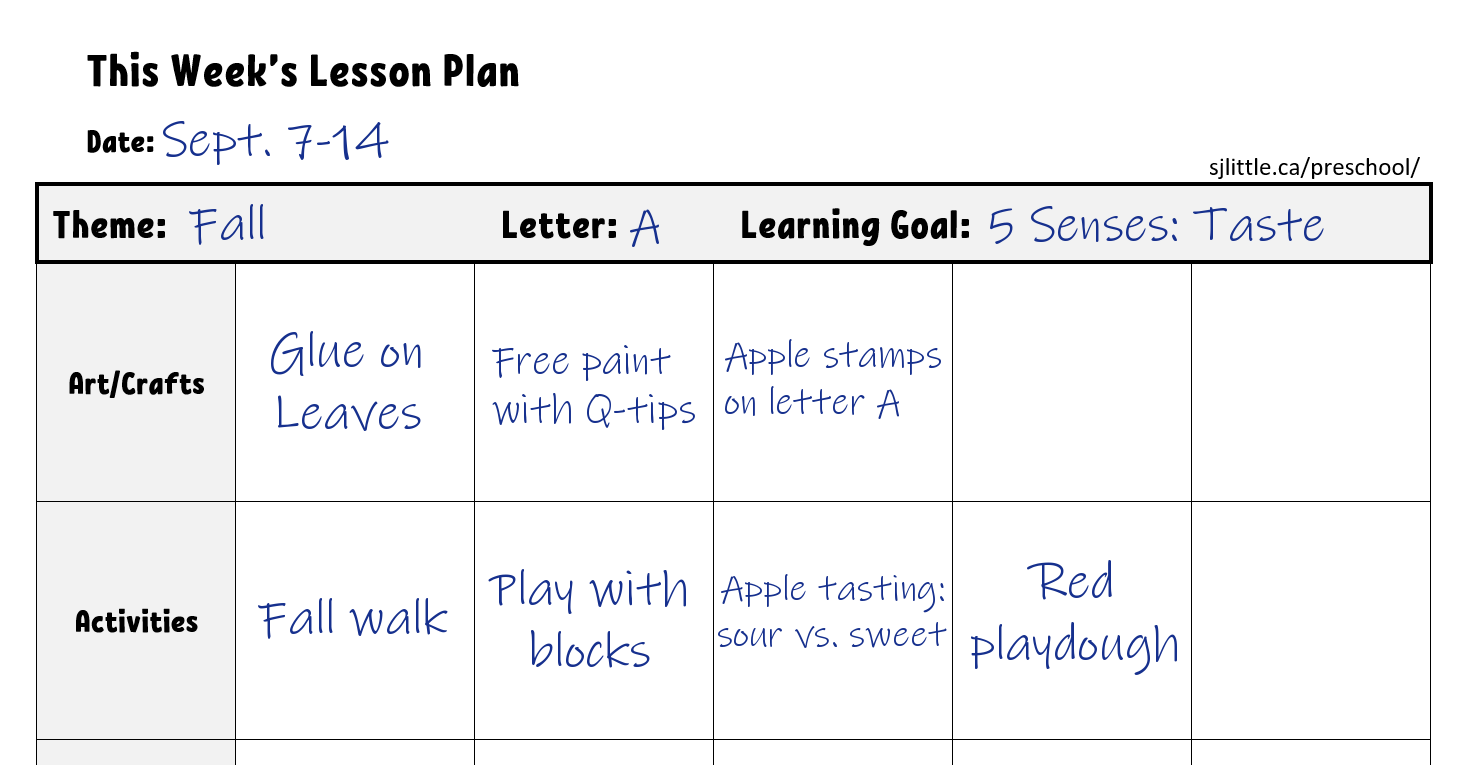
  • Your planning might look something like this:

Sample of Preschool Lesson Plan

  • Fun themes could inspire:
    • Crafts
    • Songs
    • Stories (public libraries are a great resource)
    • Games/Activities
    • Decorations
    • Field Trips (I might do 1-3 field trips per year)
    • Snacks (if you’re ambitious)

Need a Lesson Plan Template like the one above to organize your ideas? You can print this one for free when you join my email list.

Step 5: Collect Supplies and Implement the Plan

Have fun and don’t be afraid to be flexible with your preschool curriculum. Sometimes new topics or opportunities pop up that are worth switching to. Other weeks the plan simply doesn’t happen. That’s okay. Try again next week.

Remember that the preschool curriculum is meant to serve you and your children. You do not need to serve the curriculum.

An uprooted tree behind the title: Deep Roots?


How deep are your roots?

Back when I studied in Germany, there was a forested area I enjoyed slipping away to in the afternoons. This allegory is from my time there.

I pulled on my runners and slipped out the door. With a smile, I breathed in the fresh rainy air. After a morning in lectures and a noisy meal in the dining hall, it was lovely to be outside.

To fend off the chilly edge in the air I tugged on my jacket zipped.

I had a couple of hours before I needed to return to the school, so I headed past the charming little stone church built decades before and followed the street.

After a time, I veered off on a side path. It was slightly muddy due to the dampness of the day.

Softly I sang as I walked, whispering my favourite worship songs into the emptiness of the world around me.

I stooped to check on a familiar stream. It was flowing well today.

When a bird fluttered nearby I paused to watch. As it flew away, I strolled on.

At length, my way led me into a more wild section of forest. It had no paths to guide my feet, but I didn’t mind. I knew the patch of forest was surrounded by civilization on all sides. I couldn’t get too lost.

As I roamed freely among the trees, pausing to study the vines clinging to the tree trunks, or the moss underfoot, I noticed a fallen tree. Had it been there the last time I’d wandered through? I couldn’t remember.

Approaching the fallen tree, I eyed its base. How odd it was.

The tree had not broken its trunk nor torn off from its roots.

Rather, the roots had stayed with the tree and taken much of the ground with it.

Indeed as I rounded the bottom of the tree, I marvelled at the layer of rocky soil now vertically suspended nearly as high as I was tall.

I leaned closer, wondering if I could spot evidence of larger roots still in the ground. I couldn’t.

The tree’s roots hadn’t broken, but they also hadn’t been deep enough to properly anchor the tree. Not only that, but the soil into which the roots had grown was too loose and rocky to keep the tree secure.

Marvelling at the sight, I pondered what I could learn from it.

It didn’t take long to think of an application.

The Bible mentions roots several times.

One example of this is in the Parable of the Sower. The seeds sown on rocky soil have no root. They hear the word and receive it, but when trouble comes they fall away for lack of root. (You can read the parable in Matthew 13:3-8,18-23.)

Challenges come in life.

For a tree, those challenges may be strong winds, heavy snow, or simply the weight of the tree’s own branches. If the tree doesn’t have strong enough roots, it will tip over.

In the case of the tree I observed in that forest, the tree had roots, but they weren’t deep enough or in good enough soil to hold the tree upright in the challenges of life. The roots themselves didn’t break, but they took the loose rocky soil with them when they tipped.

The question to ask myself, then, is how are my roots doing? Do I have deep roots? What sort of soil are my roots anchored into? Am I anchoring my life in Jesus?

In closing, here is another place the Bible mentions roots that serves as a valuable reminder for me.

“Therefore, as you received Christ Jesus the Lord, so walk in Him, rooted and built up in Him and established in the faith, just as you were taught, abounding in thanksgiving.”  (Colossians 2:6-7 ESV)

Preschool child at circle time


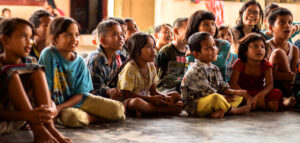
How do preschool teachers do it? How do they keep a group of 2-4 year olds listening and engaged at circle time?

If you’ve ever asked these questions, then you are in the right place. As a preschool teacher for over 9 years, here are some of the tricks I use for keeping preschoolers engaged at circle time.

1. Routine

Young children do better when they know what to expect. Having a regular routine helps children feel secure and confident. Building a routine for your day as well as a routine for your circle time will help this. It doesn’t need to be precisely to the minute. Focus more on the order of events. For example, nap time always follows lunchtime, or we always start our morning with five minutes of circle time and then it’s craft time.

  • Tips for building routine:
    • Think about when your children will have high or low energy. For some children, doing a high-energy activity immediately followed by a quieter sitting activity can help improve focus.
    • Use transition songs:
      • For sitting down (after standing songs or activities during circle time)
      • For the beginning and end of circle time
      • For clean-up time
      • For transitions to or from regular activities such as nap time

2. Change It Up

Once you’ve established a regular routine, consider changing minor elements of that routine to add variety. Children are naturally curious and desire to explore. Adding variety within routine helps keep preschoolers engaged and attentive. Try to balance and interchange new and challenging with familiar and comfortable.

  • You could do this by:
    • Always beginning your circle time with the same hello song, but then change up the next song every few days to keep it new and engaging.
    • If you teach about a letter every day, introduce it the same way each time, but then use a variety of ways to teach it. Here are some of the ways I like teaching the ABCs: Teaching the ABCs at Circle Time.
    • Introducing new songs. Children who attend several days a week can sing the same song every day for a few days, but then benefit from something new. Depending on your class and the time of year (children get wiggly in spring), you may find it helpful to introduce new songs more or less frequently. After a week or two, you can sprinkle in older songs every so often. My Big List of Simple Preschool Songs can help you find new songs.
    • Using a fun theme, such as one listed in this article: Exciting Preschool Themes, can help you find inspiration for new songs, crafts, activities, and stories. Once you’ve decided what your theme is, try searching Pinterest or Google for great ideas that go with your theme.
    • Find new picture books to read with your class. Your local library can help with this. I like to search for books based on the fun theme I’m using. With my two or three year old class, I might occasionally re-read a book at circle time. With a four or five year old class, I almost never re-read a book since new books tend to capture their attention better. (Yes, that means I am regularly visiting the library and returning with armloads of picture books.)
    • Tweak familiar games, activities, or crafts by changing the theme. This could be as simple as finger painting on an apple-shaped piece of paper rather than a regular paper. As for games, here is a simple game that can easily be adapted to various themes: 4 Sides.

3. Interaction: It Shouldn’t Just Be The Teacher Talking

Try to add interactive elements to your circle time so that your preschoolers can actively participate.

  • Interactive elements could include:
    • Singing action songs. These songs provide a level of interaction to circle time but don’t stop there. (Here’s a great list of action songs you could sing.)
    • Asking questions. Ideally, ask questions that every child gets an opportunity to answer. With a large group, open-ended questions may take far too long to allow the children to answer. Instead, for example, when your theme is pets, try asking each child a simple question such as, “What is your favourite type of pet?”
    • Encouraging participation. Watch how you react when a child attempts to add a comment or answers a question with the wrong answer. Your tone of voice and body language will tell the whole class whether their participation and attempts to answer even when they don’t know the correct answer are welcomed or not.
    • Using visuals. Including an activity with visuals the children can hold and touch helps keep them interested at circle time.
      • Matching – Make some matching visuals, such as my free Zoo Animal Skin Matching set. Secure one of each match on the wall or bulletin board. With the matching visuals, invite each child to come up one at a time. Hand them a visual and have them match it to the visual on the wall. Be sure that you have enough visuals for each child to have a turn. If you don’t, consider reusing some of the matches until every child has had a turn.
      • Sorting – Similar to “matching” above, have some visuals the children can hold and a background to sort them on. Invite them to come to the front one at a time. Give them a visual and encourage them to place it on the appropriate part of the background. This can work well for sorting colours, or dividing vehicles into land, air, and water vehicles.
      • Singing – I have a set of Old McDonald puppets I made from colouring pages. On days when I have enough time for every child to have a turn, I invite one child at a time to come stand with me at the front and choose one animal. They get to hold the animal while we sing that verse and then return to their spot on the carpet.

4. Keep It Short

When beginning a circle time routine, start short. Only do circle time for a few minutes at a time the first few days. Gradually, as the children get used to having circle time, you will be able to make it longer. However, be careful not to go too long. Otherwise the children will begin losing interest and you’ll have a harder time keeping them engaged.

  • A good rule of thumb is that a child will have as much attention span as their age. For example, a 3 year old will likely be able to pay attention for 3 minutes. Therefore, for 3 year olds, keep the pace of circle time fast. Don’t spend more than 3 minutes on each song, story, or most activities.

5. Alternate Between Quiet Listening, Singing While Sitting, and Standing With Big Actions

Especially if you have a wiggly class, finding excuses to have the children stand up or do full-body actions will help them be able to sit attentively for other parts of circle time. Using transition songs can be helpful when it is time to sit back down.

  • Ways to get your children standing up include:
    • Stand-up songs, such as this one: The Flamingo Song.
    • Rather than simply counting something, such as the days on the calendar, invite the children to stand up and stomp the number you are counting – one stomp for each number you say.
    • Do stretches.

6. Pay Attention: Are Your Preschoolers Engaged or Distracted or Bored?

Your children will give you cues. Each day, take time to reflect on how circle time went and how you might be able to improve it next time.

  • Are you struggling to get the children to stay sitting? You might need to find something new and exciting for circle time. Alternatively, if it is the younger children who aren’t engaged, you may need to find something simpler and more interactive for circle time.
  • Are your children goofing off when you read a book? Perhaps it’s time for a shorter and more engaging book such as one of these: 7 Fantastic Animal Guessing Books or try one of the methods in my article about Ways to Engage Preschoolers with Stories.
  • If there is another adult in the room, reflect with them on which part of circle time you seem to be losing the children’s attention. Sometimes an adult watching from the back of the room will be able to pick up on signals you might not be able to see while you are leading circle time.

7. Be Engaged

  • If you (and any other adults in the room) are interested in circle time, your children are far more likely to be interested and engaged as well.
  • Make eye contact with the children while you lead circle time.

8. Pick Your Battles

Choose carefully which behaviours you allow or disallow during circle time, especially when you are the teacher leading circle time. Every time you interrupt what you are teaching to correct a child’s behaviour, you are in danger of losing the attention of the other children.

  • Do your children really need to sit cross-legged at circle time? In some situations, yes, but in other situations, allowing them to sit with their legs stretched out in front may be just fine.
  • Is a child speaking out of turn? Glance around to see if they are distracting the other children. If not, you may be able to ignore their comments for the time being.

Mastering the art of keeping preschoolers engaged and listening at circle time is a skill that takes time to be learned. Even a teacher, who has led successful and engaging circle times for years, may find him or herself needing to step back and re-evaluate when a new class isn’t responding as expected.



So what is my final piece of advice? Take time to pause and reflect about how circle time went each day and try to think of one thing you could improve the next time around. In this way, you will develop the skill of keeping preschoolers engaged during circle time.

Need help choosing which type of seating to use for your circle time? Read 5 Types of Storytime Seating

Looking to create your own curriculum? Here’s a great place to start: Create Your Own Preschool Curriculum for Free

A golden gift behind title: The Perfect Gift


Have you ever received a gift from someone that you didn’t know you wanted, but when you received it, it fit a need or want wonderfully?

That was my experience recently.

One morning last week, I glanced outside. I needed to drop some Christmas cards in the mail.

I checked the weather app on my phone. -17C with wind chill making it feel like -21C. That’s cold.

Despite the fact that the mailbox was not far away, I bundled up carefully. An extra sweater under my winter jacket, two layers of gloves, a neck warmer and a toque (or beanie for those of you not from Canada). I pulled on my winter boots. That ought to do it.

I frowned, however, when I zipped up my winter jacket. I’d worn the same sweater beneath it just the week before, but this time the zipper felt tighter.

You see, I’m pregnant. My middle is quickly expanding and now pushing the limits of my winter jacket.

I shrugged it off and headed outside.

The fresh air greeted me and the sun was shining, though it did nothing to melt the snow on the sidewalk.

I strolled to the mailbox and back, enjoying the outing.

As I stepped back into the house, I felt reluctant to leave the freshness of the outside world. My layering had worked. I wasn’t cold yet.

I glanced at the snow shovel sitting near the doorway. There wasn’t a lot of snow, but the sidewalk could use some shovelling. My husband would gladly do it, but he wouldn’t be off work until after dark and it would be colder then.

Deciding to go for it, I picked up the shovel and got to work. I was careful to go slow and not do much lifting as I cleared the sidewalk.

Not long afterwards, when I headed back inside, I smiled. How refreshing to have been outside and to have moved my muscles.

Later that day, when my husband got off work, I commented to him that I hoped my jacket would last the next week or two of colder weather, but wasn’t sure it would last much longer.

I figured that if I wore enough sweaters then I might be able to get by with having my winter jacket unzipped. Especially since we typically don’t have too many days that are so very cold. Alternatively, I could try buying a maternity winter jacket, but I wasn’t sold on the idea.

Anyways, that evening we visited with one of my sister-in-laws. As we prepared to part ways, she handed us some Christmas presents. The plan was to open them on Christmas day. However, she spoke up and insisted that I open mine before leaving.

I hesitated, but finally conceded.

When I opened the cutely decorated gift, I found a piece of fabric with zippers on it. Holding it up, I discovered it was a jacket insert.

Right away we tested it on my winter jacket. It fit well.

The insert attached to my jacket zipper on both sides, making the jacket bigger. Now I could continue to wear my jacket even as my middle grew larger.

I smiled. I had not thought to put anything like it on my Christmas wish list, yet it was exactly what I needed.

It was the perfect gift.

Gifts are on my mind a lot around Christmas time. I try to think of meaningful gifts others would appreciate. At the same time, my family asks me what I want, so I brainstorm a list of ideas.

There is a lot of shopping to do and sometimes coordinating to buy bigger gifts. Sometimes I think I’ve found the perfect gift for someone, other times I’m not so sure.

Then there are the many gifts that money can’t buy. The list of things to be grateful for is long. 

There are so many ways that God blesses us. Often we take them for granted and forget to say thanks.

Many of the gifts God gives us are similar to that perfect gift my sister-in-law gave me. It wasn’t something I had thought to ask for, but it met a need wonderfully and in the nick of time.

Around Christmas time, we often pause to remember the gift the Father gave us when He sent Jesus to be born on earth. Yet that gift would not matter much if it weren’t for what it led to.

It was when Jesus died on the cross and then rose again that God granted us the ultimate gift. It was a gift we didn’t know we needed, but He gave it to us at the perfect time.

The Bible tells us:

“For God so loved the world, that He gave His only Son, that whoever believes in Him should not perish but have eternal life.” (John 3:16 ESV)

“For the wages of sin is death, but the free gift of God is eternal life in Christ Jesus our Lord.” (Romans 6:23 ESV)

This Christmas, beyond all the other gifts the season may bring, I want to celebrate the gift the Father gave us in sending Jesus to come in the flesh. Beyond that, I want to remember the ultimate perfect gift He gave us by taking away the wages of sin which I deserve.

Because Jesus died on the cross and rose again, I can have fellowship with God. The barrier sin caused between us has been torn down. Praise the Lord for giving us such a perfect gift!

“For by grace you have been saved through faith. And this is not your own doing; it is the gift of God, not a result of works, so that no one may boast.” (Ephesians 2:8-9 ESV)