11 Quick and Wholesome Snacks for Preschool - Inexpensive and Healthy Ideas by teacher S. J. Little

I get it. You’re busy, and you’re on a budget, but you still want to pack a wholesome snack for your child. What follows are some ideas for quick, easy, healthy preschool snacks that won’t break the bank.
As a preschool teacher, I’ve seen countless snacks sent with the children in my class. Some are fantastic while others are, well… not so beneficial.
Before I continue, I’d encourage you to be familiar with your preschool’s snack policy. Most likely it includes being peanut or nut-free. It may also include other things.
Disclaimer: The following suggestions are to be used at viewer discretion as every child and preschool is unique.

Fruit and Vegetable Snacks

    1. Fresh Fruit/Veggies
      • A classic for excellent reason! Sending fresh fruit or veggies for your child is super healthy.
      • I recommend cutting the fruit for your child rather than sending the fruit whole, unless you expect them to eat the whole thing. I have had many a time when a child eats one or two bites of an apple or banana, then throws the rest in the garbage.
      • When cutting fruit, and with small round foods such as grapes and cherry tomatoes, be aware of their potential as choking hazards.
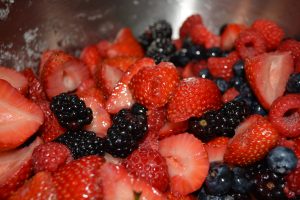
      • Possible fruit or vegetables: banana, apple, orange, peach, Berries - 11 Quick and Wholesome Snacks for Preschool - S. J. Littlepineapple, grapes, berries, melons, carrots, celery, cucumber, tomato, snow peas, bell peppers, and so on.
    2. Frozen Veggies/Berries
      • Recently I discovered a forgotten bag of green beans in my freezer. This quickly became one of my quick and easy go-to preschool snacks.
      • Put a small handful in the microwave for a minute or two. Let them cool briefly, then stick them in a container.
      • I like to add a touch of salt and oregano to spice it up, but that’s optional.
      • Possible frozen items: green beans, broccoli/cauliflower/carrot mixture, peas and corn, berries, Brussels sprouts, or anything really.
    3. Cooked Veggies
      • This is another of my favorites. It’s healthy while still being quick and easy. My favourite is broccoli. I take enough to fill my small snack container, cut into easy finger-food size, then stick the pieces in the microwave with a touch of water for a minute. The microwave softens the broccoli so it’s easy to eat without dipping.Broccoli - 11 Quick and Wholesome Snacks for Preschool - S. J. Little I often add a touch of salt and spices such as oregano or coriander.
      • Possible veggies: broccoli, cauliflower, carrots, cabbage (in small portions), among others.
    4. Dried Fruit
      • I enjoy dried fruit. However, use your own discretion as to how healthy or not these are. Store-bought dried fruit may have additives or could be a concern if your child’s teeth are not being brushed well. However, they are certainly healthier than many other options.
      • Possible dried fruit: raisins, banana chips, cranberries, dates (pitted), mangoes, apricots (pitted), etc.
    5. Applesauce
      • Individual applesauce cups can be a healthy option, especially if you get the unsweetened kinds. However, be sure your child is comfortable using a spoon by themselves before sending this snack with them.

Other Ideas for Preschool Snack

    1. Leftovers
      • Have leftovers from a meal your child enjoys? Why not send them along as a snack. Just be sure your child is able to eat the leftovers independently, whether that means using a spoon or whatever is needed.
      • Options: pasta dishes, grilled cheese sandwiches, chicken nuggets, pizza, pancakes, perogies, or rice with lentils or other sauce, to name a few.
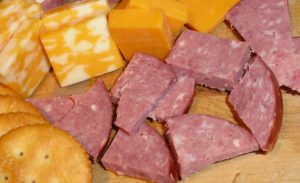
    2. ProteinProtein - 11 Quick and Wholesome Snacks for Preschool - S. J. Little
      • It’s often a good idea to include a source of protein in your child’s snack
      • Protein options: cheese, cream cheese, slices of meat, pepperoni sticks, scrambled eggs, a hard-boiled and shelled egg, and so on.
      • Beans, hummus, and yogurt can also be included for protein. I’ll give more ideas regarding those below.
    3. Hummus
      • Hummus can be sent as a dip for veggies, or spread on pita bread, a tortilla, or a slice of bread.
    4. Yogurt
      • Fruit yogurt is another good and common preschool snack item. I discourage sending yogurt tubes as those easily make a large mess when squeezed. Individual yogurt cups, or pouring a small amount of yogurt into a reusable container works well if your child is confident using a spoon. Yogurt drinks are also decent options.
    5. Beans
      • This one might sound weird, but don’t cross it off the list too fast. Next time you dump a can of chickpeas or black beans into something, eat a few plain. I knew a child who enjoyed snacking on chickpeas. I would only give beans in small amounts, and along with other snack items. They are a simple healthy addition to preschool snacks.
    6. Crackers/Cereal/Bread
      • While I don’t recommend sending a snack consisting entirely of these sorts of foods, having some along with fruit, veggies, or other foods can make a snack feel more complete and filling.
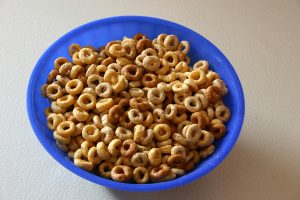
      • Crackers – there are many types of crackers available. Some are far healthier than others. Check the ingredients for things such as artificial colour or flavouring. For a bit of variety, try rice crackers, pretzels, or plain graham crackers.Dry cereal - 11 Quick and Wholesome Snacks for Preschool - S. J. Little
      • Cheerios or other low sugar cereal that can be eaten dry is another option to consider.
      • Pita bread, tortillas, naan, and chapatis are among the many types of breads you could send with your child. Perhaps spread a little cream cheese, jam, or hummus on it to add flavour. (Be wary of chocolate spreads as they often contain nuts.)
      • Raisin bread – buy or make your own. Cut a slice, butter it, and place it in a container for snack. With store-bought raisin bread, I prefer to toast it lightly before buttering.

I hope this list has given you more snack ideas that are practical, affordable, and easy to do, while being wholesome and healthy. Want more ideas for packing your preschooler’s snack? Take a look at this article: What Snack Options Should I Pack For My Preschooler


Is it my power, or God’s power, that brings the impact? - S. J. Little

Is it my power, or God’s power, that brings the impact?

Ah, camp. I don’t know about you, but I love being at camp. This summer I was again blessed with the opportunity to volunteer at a Christian summer camp. I thoroughly enjoy such times, though, boy, can they be busy!

Each morning, with the knowledge that I’ll be hardpressed to find downtime during the day, I try to get up fifteen minutes early in order to slip out for a brief walk in the woods.

As I slipped out for my early morning walk with Jesus on the first morning, I wandered into the woods. How wonderful to be out of the city and surrounded by God’s creation.

I found a log to sit on while I stopped to read a short Psalm. Glancing at my watch, I knew I had to get moving, so I put my Bible back in my bag, and strolled toward camp singing a song of praise.

Then I heard it. I stood still and listened. Tap, tap, tap. A woodpecker must be nearby.

Slowly I turned in a circle, eyeing the trees. Could I spot the bird?Looking for woodpeckers in the forest - The Woodpecker's Power - S. J. Little

It sounded rather distant, so I started walking toward the sound. Five steps later the sound appeared to be coming from the opposite direction. I turned and walked toward the sound again. This time I only took one step before the sound seemed to switch direction again. I was confused for a moment. Then, looking straight up the nearest tree, I smiled.

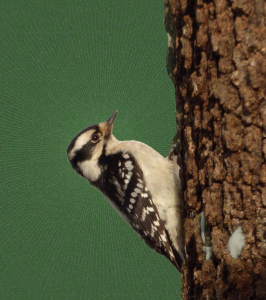
There it was. A little woodpecker.

He wasn’t a fancy woodpecker – no red crest or orange wings. He was a small brown and white bird.

He was hard at work, far overhead, pecking away at the tree.

I dared only stay a minute or two, as I couldn’t be late for staff devotions, but what a lovely way to start the day. I spoke a prayer of thanks as I moved away.

Seeing the woodpecker brought to memory an allegory I’ve heard before. I don’t know who first used this allegory, but Corrie ten Boom and Jonathan Goforth are among those who’ve included it in their messages. It is a powerful reminder.

The allegory goes like this: Once there was a woodpecker. He went about hisDid the tree split because of the woodpecker or the lightning? - S. J. Little business of tapping on trees, whether looking for bugs to eat or building himself a home.
One stormy day, as he pecked at a large sturdy tree, a bolt of lightning struck the very tree he was tapping on. The tree split in half.

The little woodpecker blinked. Then lifted his head proudly. “I didn’t know I had such power!”

Of course, I know it was not the woodpecker’s power that split the tree. The power belonged to the lightning. 

The little woodpecker was helpless to take down the tree by himself. Likewise, I am helpless to bring people closer to God in my own power. God’s power must be at work.

Keeping that in mind, I appreciate how this allegory goes a little further. Allow me to explain.

God has instructed me to work with all my heart, on whatever has been placed in front of me, as working for Him. (Colossians 3:23)The woodpecker thought it was his own power that split the tree - S. J. Little

The woodpecker exemplified this in that he was pecking away at that tree. He wasn’t sitting lazily on the branch. He was doing the job he was given to do with all his heart.

It was as he laboured at his job, that the lightning struck.

Do you see it? I am to put my heart into what God has given me to do, but the real impact happens through God’s power.

As Paul said:

“I worked harder than any of them, though it was not I, but the grace of God that is with me.” 1 Corinthians 15:10b ESV

Or as the New Living Translation puts it: “For I have worked harder than any of the other apostles; yet it was not I but God who was working through me by His grace.”

Oh, that I would never forget what the woodpecker forgot, that even as I work for the Lord with all my heart, it is God’s power that brings the impact, not mine.

There are endless ways to help at your child's preschool. Here are 9 unique ideas to get you started.

There are endless ways to help out your child’s preschool

Another school year is upon us. My, how time flies! As I prepare to welcome a new group of students, and you send your little one off to preschool, here are a few suggestions of helpful ways you could volunteer to support your child’s teacher.

Note that different teachers have different things that they prefer to do themselves, or different licencing rules, or needs in their class. If they say no when you offer to help, accept their answer.

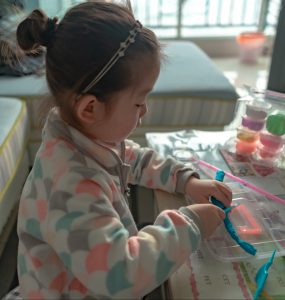
1. Make playdough9 Ways to Volunteer for Your Child's Preschool - S. J. Little

  • Preschoolers benefit in many ways from playing with playdough. Their hand muscles are strengthened in preparation for writing, their creativity is engaged, and teachers can use it as a chance to practice social and language skills. However, playdough costs money, and, with so many little hands touching it, playdough certainly does not last forever. Most preschool teachers I know would be grateful if you offered to make a batch.
  • Tips:
    • Your teacher may have a favourite recipe to share with you.
    • Making the playdough can be done with your child (depending on the recipe), which can create fun family time and an opportunity to teach them to get excited about giving something away.

2. Craft prep/cutting

  • Preschool teachers spend hours cutting paper in preparation for crafts and art projects among other things. However, I have to warn you on this one. Some preschool teachers can be extremely particular about the quality of cutting, others hardly care. Take a few weeks to watch what sort of arts and crafts your child is making, and the quality of cutting the teacher is doing. If you think you can match it, ask your child’s teacher if they would be interested in your help.
  • Tips:
    • If you take something home to work on, be sure to get it back to the teacher at or before the agreed time.

3. Donating your skill/expertise

  • Sewing
    • Is sewing something you enjoy and have decent ability in? Tell your child’s teacher. She may have a cloth doll or a dress-up costume in need of a few stitches. Alternatively, offer to make a few simple costumes for the dress-up corner such as a couple of tutus or capes.
  • Computer skills
    • Not all preschool teachers are skilled with computers. If your child is at a small preschool, an offer to help polish their website, etc. may be eagerly received.
  • Community Helpers
    • A common preschool theme is community helpers. This includes individuals such as firefighters, police officers, doctors, dentists, vets, and librarians. Even construction workers and bus drivers could be included. If this is you, and you enjoy talking with preschoolers, ask your child’s teacher if they would be interested in having you talk about your job for a couple of minutes in class. This would be especially beneficial if you have some sort of items to show the children or even to let the children touch.

4. Donating resources

  • Wood
    • Does your job involve working with wood? What may be scraps of wood destined for the garbage bin to you, may be treasures to your child’s teacher. I once had children make a keepsake craft out of donated flat baseboard. It was a hit!
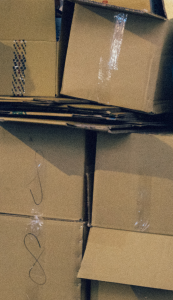
  • Boxes and paper9 Ways to Volunteer for Your Child's Preschool - S. J. Little
    • Does your job involve very large cardboard boxes? Rather than throwing out or recycling a large box, ask if your child’s class could use it. Do you often have stacks of unused, clean paper to get rid of? Offer it to your child’s teacher. Even if the papers are too small for your purpose, many teachers would welcome papers as small as, say, 3″ by 3″.

5. Field trips

  • Preschools often have a set number of adults needed for field trips and other unique activities. Finding that number of parents willing to come can be challenging. I have had to cancel activities in the past because not enough parents volunteered.

Tips:9 Ways to Volunteer for Your Child's Preschool - S. J. Little

    • Keep an eye open for announcements about field trips or other activities and ask your teacher if they’re looking for volunteers.
    • When volunteering, remember that you are there to watch the children, not primarily to stand to the side talking with other adults.
    • Come prepared. Dress appropriately for the activity.
    • Be aware that some children react unexpectedly when their parent is volunteering. More on that later.

6. Special events

  • Does your child’s preschool have a Valentine’s party, a picnic day, a Halloween parade, a Christmas party, or a multicultural day? Ask the teacher if they would like a volunteer to help. Depending on the activities planned and the particular group of children, they may say yes or no.

7. Washing toys

  • Did you know that preschool teachers wash their toys a lot? Some preschools wash toys weekly, others wash them monthly. Whatever the case, if you offer, they may be very happy to accept an offer to help wash some toys, or, based on a variety of reasons, they may have to say no. Note that toy washing is not a glamorous job and is often monotonous.

8. Donations

  • Depending on your particular preschool program, your child’s teachers may gladly welcome a variety of donations. Many of these items could be donated when your child outgrows them. Be sure the items are in good shape prior to donating and age appropriate. These items could include:
    • Clothes (Keeping extra clothes on hand for when a child has an accident but didn’t bring a change of clothes is important.)
    • Plastic grocery bags (Clean and without holes. These are valuable when a child has an accident, or for a variety of other purposes.)
    • Clean diapers (If your preschool has a non-toilet trained class extra diapers are great!)
    • Toys
    • Halloween costumes (When a child forgets to bring a costume, having a spare costume for them to use is wonderful.)
    • Dress-up clothes, including multicultural outfits
    • Snow pants, gloves, swimsuits (If your school does activities requiring these items, having a spare can be a lifesaver.)

9. Volunteering in the classroom

  • Now I suspect the first thing you think of when someone suggests volunteering for your child’s preschool, is staying in the classroom as an extra set of hands. There is a reason I didn’t put this first on the list. Every school has their own policy on this: some encourage it, some discourage it. Wonder why? There are several reasons.9 Ways to Volunteer for Your Child's Preschool - S. J. Little

It is always intriguing to me to watch the way a child’s behaviour changes when their parent stays in the classroom for a day. Some children barely change their behaviour, while others can go from perfectly behaved and good at listening, to rolling on the floor in a temper tantrum. Others can go from mischievous to well behaved. I suspect it depends a lot on how the child responds to the parent at home. This is why some preschools discourage parents from staying in the classroom, at least for the first couple of months of the school year. It is not because they don’t want the help, or because they are trying to hide anything, but because sometimes having a parent volunteer is more trouble than help.

  • Tips:
    • If your child cried the first couple days of school (many do), then volunteering to stay in the classroom right away may not be beneficial. If your child has just begun to settle in, your presence may throw that off and slow the adjusting process. Instead, wait until later in the school year to volunteer.
    • The first couple of days of class can be hectic. Some preschools bring in extra staff or volunteers to help. If you have childcare-type experience and your child is not disrupted by your presence, the teacher may welcome your help.
    • Respect your preschool’s policies surrounding parent volunteers. They are there for a reason.

Conclusion

I hope this list has given you food for thought when it comes to volunteering for your child’s preschool. There are endless ways you can help. When you save the school money, by donating items, or save the teacher time, by volunteering for tasks, you enable that time and money to be spent in other ways to provide an even richer preschool experience for your child. However, as mentioned, keep in mind that each preschool is different and may have different needs and policies. What may be a tremendous help to one teacher, may not be welcomed by the next.

On behalf of all the teachers and preschoolers who will benefit from your volunteered time, skills, and/or resources. Thank you!

Am I following God, rather than trying to lead Him? My cat isn't good at following me! - S. J. Little

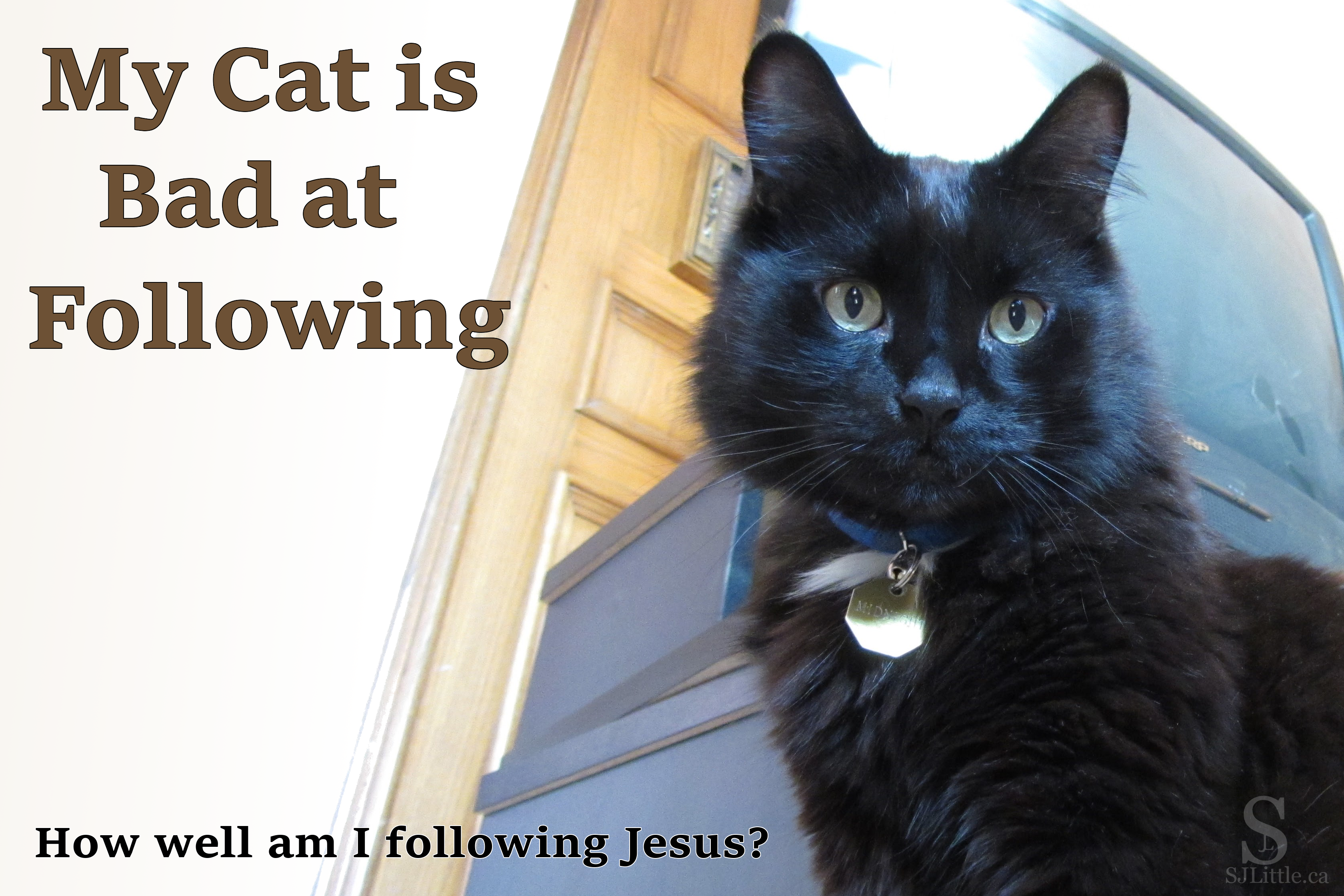
How well am I following Jesus?

Meet My Cat  

I have a cat named Midnight. He is quite the character and has become very social.

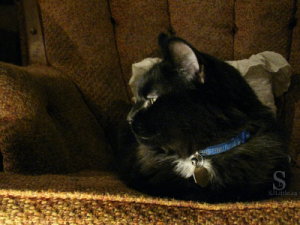
My cat looking to the left. - S. J. LittleWhen he was younger, we had his brother as well. Midnight would always let his brother do the talking. I remember watching my siblings try to coax even the tiniest mew out of him with little success. In the years since his brother passed away, however, Midnight has found his voice. Now he often shares his opinions loudly, though at times he merely squeaks.
It’s funny how cats have their own personalities. If you’re a cat lover, you may understand. Midnight’s favourite human food to beg for is the milk left after cereal. His brother, however, was far more interested in ice cream. When Midnight begs for a bowl, he’ll sit a distance away with his back towards the person. As they reach halfway through their meal, he might move a little closer and peek at the person. Only once the spoon is scraping the bottom of the bowl, will he sit at the person’s feet peering up at them. His brother was the opposite. He would boldly sit by the person, staring at them as they ate. With his old age, Midnight is beginning to pick up some of his brother’s boldness.

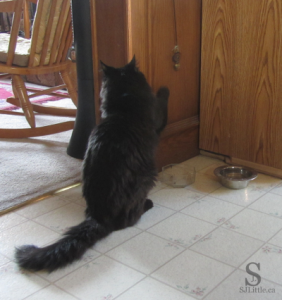
My cat rings a bell when he wants more canned food. That way it doesn't dry out when he isn't hungry - S. J. Little
Midnight ringing the bell for food.


Midnight is also a very smart cat. He’s learned to open doors. At one point, we had to devise a lock for the cat food closet so he and his brother wouldn’t break in. We’ve trained him to ring a bell when he wants canned food, and I’ve taught him to find some place other than my keyboard to lay down when he wants to cuddle but I’m busy on my computer. Yes, he is a smart cat… most of the time.

He’s Not Good at Following

The one thing he has never seemed to learn is how to follow well.

It has happened often that, when I head down the hallway, he gets excited and wants to come along. I start down the hallway at a decent clip, and he hurries just ahead of me, as though trying to lead me. As I turn to enter a room, I trip over him, because there he is, right where I was planning to step.

It gets worse. Sometimes he will zig zag directly in front of my feet! Not only that, but, looking from above, his coat appears entirely black – not a helpful thing in a dark hallway at night.

I’ve lost count of the number of times I’ve accidentally kicked him because he dodged directly into my path. That’s not including the times I’ve managed to avoid him by stumbling and almost falling myself.

What a silly cat. He’s so eager to go with me, and even lead me, but doesn’t know where I’m going. How can he lead when he doesn’t know the direction? He could have saved himself many a bump if only he’d learned to follow.

Following God

Following – that’s what God calls us to do. We are to follow Him.

As you read through the Gospels you’ll quickly see that Jesus often called people to follow Him. Most times there is no record of Jesus telling them where He would lead them, or what their life would look like, but the call to follow is there.

How to Not Follow God Well – Like My Cat

Did you know there are examples of people in the Bible who tried to get ahead of God when it felt as though He was taking too long? 

Abraham and his son Ishmael are a blatant example of this. God had promised that Abraham would have countless descendants, but many years passed without Abraham having a single child. Abraham and his wife Sarah were old. They decided that rather than waiting for God any longer, they would help Him out by taking matters into their own hands. Abraham took Sarah’s maid as his wife and had Ishmael by her. That was not following God’s plan, and later their actions led to trouble in their family. You can read the story for yourself in Genesis, especially chapters 16-17, 21. My black and white cat sitting on an orange chair. How well are you doing at following God? - S. J. Little

Another way to not follow God is to run in the opposite direction as Jonah did. That never turns out well in the end! (Jonah 1)

Am I trying to get out ahead of God, or running in the opposite direction, instead of following Him?

Thoughts About Following God

So much could be said about following God, but this is just one blog post. There’s no way I can fit it all in! I’ll try to stay brief. 

Throughout the entire Bible, we see God leading people. Sometimes His leading made sense to those following, but there are also many times when it made no sense at all! Take Jericho for example, or Naaman. (Joshua 6; 2 Kings 5)

Sometimes following God means waiting, such as in Acts 1:4, when they waited for Pentecost. However, waiting doesn’t mean sitting idly. In Acts 1:14-26, they spent the time praying and they chose a man to replace Judas. They were doing what needed to be done, while seeking and waiting for God. I’ve long loved Psalm 37:34: “Wait for the Lord and keep His way…” Yes, we must wait for God, and that time of waiting often includes going about our daily lives in a way that is honouring to God.

Are You Following God?

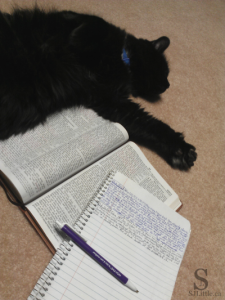
My cat trying to help me study the Bible. - S. J. Little
Midnight trying to help me study the Bible.

I wish I had some concrete formula for discerning whether or not I am following God well. If I had such a formula I would gladly share it with you, but I don’t.

Following God can look very different in different people’s lives. Even in one person’s life, following God may appear very different in each season.

What I can say is keep seeking after Jesus. Read the Bible often, spend time in prayer, and be in fellowship with others who know Jesus deeply. Then He will guide you, and if you’re not following Him, He will reveal that to you and help you change course. Sometimes His leading will be loud and unmissable, but other times it may be a quiet door opening that, after prayer and consideration, seems good to step through.

Final Thought

Let me leave you with a likely familiar verse from the Bible.

“Trust in the Lord with all your heart,

and do not rely on your own understanding;

in all your ways know Him,

and He will make your paths straight.”

Proverbs 3:5-6

Are you following God today?

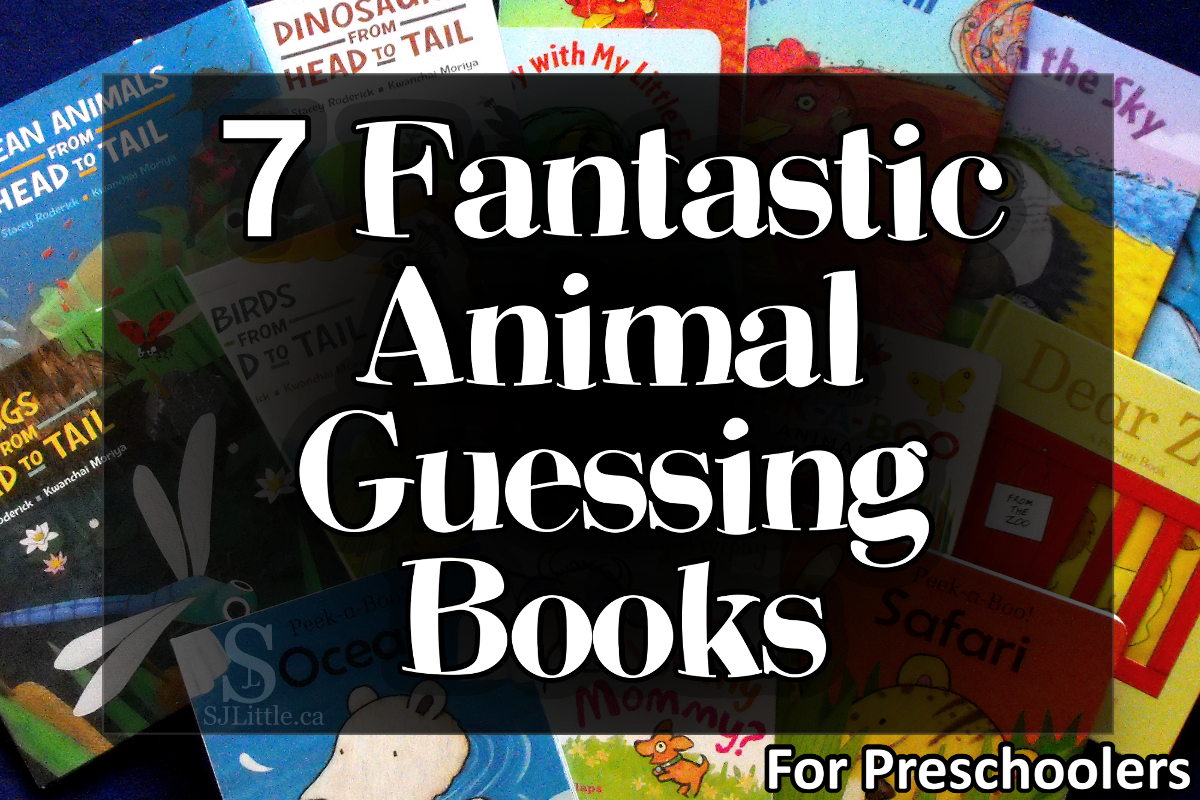
The following are some of my favourite animal picture books that get children interacting at storytime. These guessing books for preschoolers give clues, whether visual or through words, about what animal may be hiding on the next page or under the flap. Especially at the beginning of the school year, I find these books intrigue youngsters who are otherwise unwilling to sit for stories.

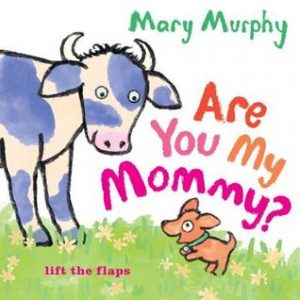
1. Are You My Mommy?

(Lift the flap)

Written and Illustrated by Mary MurphyAre You My Mommy? by Mary Murphy - review by S J Little

This is currently one of my absolute favourite preschool books. The storyline – a puppy looking for his mommy – is simple enough for my two year old class to follow and enjoy. As the puppy asks each hidden animal if they are his mommy, the children try to guess the animal based on visible clues. My two year olds enjoyed naming each farm animal after I opened the flap, while my three year olds were typically able to guess the animal before I opened it. Now here’s the part that makes this little board book so fantastic. I found that most of my three year olds were well versed in, and becoming bored of, the typical farm animal names: horse, cow, pig… In fact, many of my two year olds knew them all. Mary Murphy doesn’t stop with just the standard farm animals. Instead, under each flap is a baby to go with the mommy. These baby animal names were brand new for my three year olds. They hadn’t heard of ducklings, piglets, and calves before. This kept my advanced students engaged and learning while still providing review of the standard animal names for my children who were newer to learning English.

Reading tips:

  • By using identical phrasing on each page you can invite your children to say it with you: “Are you my mommy?” “No, I’m a ___(allow children to name the animal)__, and this is my baby calf.”
  • I like to use a different voice for each animal. It helps the children stay attentive.
  • Because this book is, to my knowledge, only available as a small board book, some older preschoolers may scoff at it as being for babies. Therefore, how you introduce this book is important. I like to tell the children I need their help naming the animals. Also, because the baby animal names were new to my class, I decided to read it on two days during our farm week. To prepare the children for this, I told them I was going to read the book today, and then a different day I would read it to them again to see if they remembered it. This way I didn’t get any “we already read that” complaints when I pulled the book out the second day.

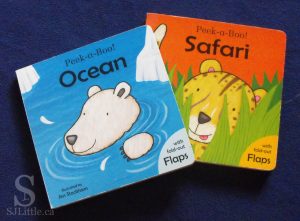
2. Peek-a-Boo! Ocean

(Lift the flap)

Written and Illustrated by Jess StockhamPeek a Boo! Ocean and Peek a Boo! Safari by Jess Stockham

This series of books is right up there among my favourites. They are good-sized board books with only 5 page spreads each. The sad thing about these books, however, is that, to my knowledge, they are no longer in print. Also, since children are often rough on lift the flap books, they are quickly disappearing from my local library.

As a preschool teacher, I find that many children have trouble settling into our circle time routine during the first number of classes. Especially with my two year olds, I find it works best to start with songs for the first few weeks, then slowly transition to adding some books in those times of singing. These Peek-a-Boo books are excellent first books for circle time during that transition. With my two year olds, I might wait a month before beginning to introduce these books and then moving to other books, while for the three year olds I’d start with these books in the first week or two.

What’s so great about these books? Let me tell you. My favourite part is the way Jess Stockham has left little clues visible so the children can try to guess which animal is hiding behind the flap. For example, the children might be able to see the animal’s tail or ear. Another thing I appreciate about this book is how bold and simple the pictures are. On top of that, the flaps are large, nearly as large as the book.

Reading tips:

  • When you read the words, such as “Who’s ear is this?” Point to the place where you see the ear peeking out from behind the flap.
  • After opening the flap, your children might enjoy it if you tell them something about the animal, such as the sound it makes or where it lives, for example: “The polar bear lives at the North Pole where it is really cold.”

Other titles in this series include:

  • Peek-a-Boo! Safari
  • Peek-a-Boo! Forest
  • Peek-a-Boo! Jungle

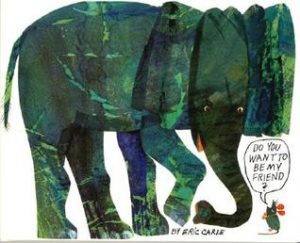
3. Do You Want to Be My Friend?

Written and Illustrated by Eric CarleDo You Want To Be My Friend? by Eric Carle - review by S J Little

This nearly wordless picture book is a lot of fun for 3-4 year olds. Each page shows the tail of the animal you will see when you turn the next page. Children enjoy trying to guess which animal each tail belongs to. The book includes a wide variety of animals some of which my three year olds were not familiar with. The variety of animals would fit well with a zoo theme. When I tried this book with my two year olds, it seemed too long and the animals and their tails too tricky for guessing. Therefore, I’d recommend this one for 3-4 year olds.

Reading tips:

  • Only two of the pages have words on them. I typically end up repeating the same phrase on every page: “Do you want to be my friend?”
  • Wait a moment before turning the page and encourage the children to guess.

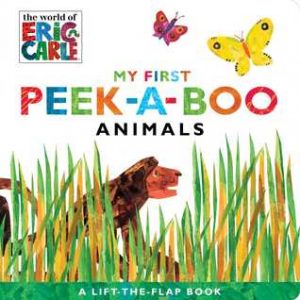
4. My First Peek-a-boo Animals

(Lift the flap)

Written and Illustrated by Eric CarleMy First Peek-a-boo Animals by Eric Carle - review by S J Little

This short book is unique. Each page has a four line poem giving clues to what animal might be hiding behind the flaps. The large flaps do not cover the entire animal leaving toes, tails, and maybe a nose sticking out. 2-4 year olds can enjoy this book, however, I would say that my two year olds were not able to guess based on the poems. Also, as a teacher at a preschool that uses typical themes, I find it hard to know which theme to use this book in. It has a random combobulation of animals from a lion, to a horse, to a butterfly, to a turtle, to an elephant and more. Still, regardless of what theme you put it under, this is an engaging book for preschoolers.

Reading tips:

  • Based on the age and development level of your children decide whether or not to read the poems. If you wanted, you could encourage the children to guess simply based on the visual clues sticking out from under the flap and read the poem after you’ve revealed the animal.

5. Dear Zoo

(Lift the flap or pop-up version)

Written and Illustrated by Rod Campbell

Dear Zoo by Rod Campbell

The simple repetitive words and basic storyline of this classic book make it excellent for youngsters. Only a couple of the pages have visual clues as to what animal is hiding making them hard to guess. Each animal has a description word, such as big, fierce, scary, jumpy, etc. These words could be used as clues to encourage guessing. They also enhance the learning side of this book as the children may not be familiar with some of the description words.

Reading Tips:

  • I highly recommend the pop-up version rather than the lift-the-flap as the pop-ups add tremendously to the excitement and engagement factor. However, note that the pop-up version is more likely to rip if left unsupervised in little hands.
  • One small group of 3-4 year olds I read this book to, enjoyed it so much that we read it several times in the first sitting. By the third or fourth time through, the children had memorized most of the animals and description words. They loved being able to fill in the words rather than hearing me read it.

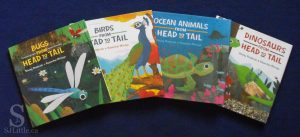
6. Bugs From Head to Tail

Written by Stacey Roderick

Bugs From Head to Tail and other books in the series Written by Stacey Roderick, Illustrated by Kwanchai Moriya

Illustrated by Kwanchai Moriya

I highly recommend the Bugs and Ocean Animals books of this fairly recent series. Both books have a wide variety of animals some of which are familiar to most preschoolers and some of which will be new to them. While these books do not have flaps to lift, the pages have been cleverly designed so that on one page you see a part of an animal as a clue, such as their feet or tail, etc. Then you turn the page to find out what animal it is.

While I really enjoy the Bird book, most of the birds are far too specific for 2-3 year olds, unless the children have a specific interest in knowing unique animal names.

Reading Tips:

  • On the page that reveals which animal it is, the animal name is given as well as a lengthy blurb about that animal. The details in the blurb are targeted for a much older age group, therefore I entirely skip them. (Also, the dinosaur book’s blurbs are primarily based on speculations about the dinosaurs’ behaviours, not known facts, so I don’t read them.)

Other titles in this series include:

  • Dinosaurs From Head to Tail
  • Birds From Head to Tail
  • Ocean Animals From Head to Tail

7. I Spy Under the Sea

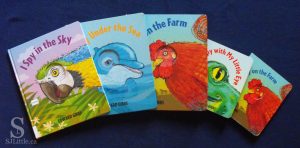
Written and Illustrated by Edward GibbsI Spy kid's guessing book series by Edward Gibbs

I was surprised how much my wiggly three year old class enjoyed this book! First, we look through a spy hole to see what’s on the next page. I read the clues, such as “my arms are called tentacles.” Then the children try to guess what animal it might be before I turn the page. My class guessed some of the animals easily while others they’d never heard of which kept the book from being boring for my more advanced children. While the artsy illustration style is not my favourite, my class had no problem with it.

To my knowledge, this series is available as hardback and board book.

Reading Tips:

  • Encourage the children to try guessing even if they’ve never heard of the animal. Be sure your response to their guesses is encouraging. Especially with the quieter children, when they gather the courage to voice a guess, be careful not to turn them off by laughing at their guess.
  • Read the book ahead of time so that you know what’s coming. That way you can provide extra clues. For example, when I read the Under the Sea book to my class, we’d seen clownfish on our field trip the week before which I was able to use as an added clue.

Other titles in this series include: (Each focuses on various preschool topics as listed below.)

  • I Spy With My Little Eye (colours and clues)
  • I Spy Under the Sea (clues and numbers)
  • I Spy Pets (food and clues)
  • I Spy in the Sky (colours, big/small describers, and clues)
  • I Spy on the Farm (colours, first letters, and animal sounds)

Interested in learning other ways to capture your young audience at storytime? Skim through these creative tips and ideas: Ways To Engage Preschoolers With Stories