
Children jumping and title "3 No-Prep Outdoor Game to Play with Your Preschooler"


As the weather gets warmer, it’s valuable to get kids outside and moving. That’s what these classic 3 games are all about. Best of all, they are no-prep outdoor games so you can play them just about any time and anywhere.

You may already be familiar with some of these games. Perhaps you played them as a child. I know I did. Whatever the case, if you’re looking for more games to play with your preschooler, keep reading.

Tips for No-Prep Outdoor Games

Before we get into the games themselves, I have a few tips for you.

  • Keep a close eye on the children’s interest level. Try to end the game just before the children begin feeling bored. This way, they will remember it as a fun game. If you wait until they are extremely tired and bored, they are less likely to enjoy the game again in the future.
  • Choose a playing space based on the age and stamina of your children. For older children choose a larger playing area, for younger children, a smaller space will do. You could use a field, your backyard, a multipurpose room, or a patio (with good railings). Get creative.
  • Have fun! If you are enjoying the game your child is far more likely to have fun playing.

What Time is it, Mr. Wolf

Even if you don’t know this game, there’s a good chance your children might. This game can be used in a variety of settings, including swimming lessons and skating lessons.

Number of Children:

  • Large group
  • Small group
  • One-on-one with an adult

Child Development:

  • Counting
  • Gross motor movements (running and stepping)
  • Turn-taking (waiting for their turn to be the wolf)
  • Following instructions

How to Play:

Select one person to be the “wolf”. Have them stand on the opposite side of the playing space. Have the other players line up side by side on the starting line.

Together, all the players (except the wolf) call, “What time is it, Mr. Wolf?”

The wolf calls back a number between 1 and 12, or “Lunchtime!”

If the wolf says, “It’s 3 o’clock,” all the players take three steps toward the wolf.

Then all the players ask again, “What time is it, Mr. Wolf?”

Whenever the wolf chooses, he can reply, “Lunchtime!” When he does, the wolf chases all the players back to the starting line.

If the wolf tags anyone before they reach the starting line, they become the wolf. For small groups of 8 children or less, just the person who was tagged first becomes the wolf and the first wolf becomes a player. For larger groups, every child who is tagged joins the wolf so that, as the game progresses, there are more and more wolves and less players.

For older children, have the wolf turn around so that they cannot see how close the players are getting. This is not necessary for preschool children and it can be tricky to keep them from peeking.

Red Light, Green Light

Fantastic for use while teaching transportation or safety themes, this game is well-loved and for good reason. While this game absolutely works without any prep, it can be improved by choosing something to use as the “red light” and the “green light”. In the past, I have used printed stop and go signs, blank red and green pieces of construction paper, red and green hula hoops, red and green cones, or whatever else I had on hand.

Number of Children:

  • Large group
  • Small group
  • One-on-one with an adult

Child Development:

  • Gross motor movements (running and stopping)
  • Ear-body coordination (hearing instructions and obeying them)
  • Listening skills (learning to respond to “stop” or “red light”)

How to Play:

Choose who will be the “caller”. The caller can be a child or a teacher/parent. Have the caller stand on one side of the playing space. Have all the children stand side by side on the opposite side of the playing area. 

When the caller says, “Green light!” all the players run toward the caller. When the caller says, “Red light!” all players must stop where they are. The caller continues to call “red light” and “green light” until all the players reach where the caller is standing. Then a new caller is selected and all the players return to the opposite side of the area.

For 8 or fewer children, allowing the children to be the caller works well. For bigger groups of preschool children, it may be best to only have the teacher be the caller. This is especially helpful if you are under tight time constraints. When the teacher is the caller they can control the game. For example, they can make it shorter if gym time is almost over.

For elementary aged children, this game becomes a challenge to not be caught moving when it’s a red light. If caught moving, they are sent back to the start line. For preschool children, remembering to follow the instructions is often exciting and engaging without being sent back to the beginning. However, if a child really isn’t responding to the red light, sending them back to the starting line will help them be more intentional to pay attention next time.

Extend the Fun:

  • Extend the fun by adding more colours. This works especially well if you have visuals to hold up for each colour. Some ideas include:
    • Orange = go slow
    • Blue = (stop and) turn around
    • Purple = hop
  • Are you doing a transportation or safety theme? Try making visuals representing the stop and walk crosswalk signals to help children learn what they mean.

Mother May I

I recommend this game for a small group of 3-5 children who are aged 3-5. This is due to how slow the game can be when each child moves separately. For larger groups, try having all the children take the steps together, much like What Time is it Mr. Wolf.

As an adult, this game may seem pointless, but many children love it. They enjoy having the power to make choices when they are the “mother”. Be careful to ensure that every child has a turn to be the mother.

If you are uncertain about using this game’s traditional name “Mother May I” try calling it something like “Monkey May I”.

Number of Children:

  • Small group

Child Development:

  • Variety of gross motor movements (large steps/small steps, and if extending the play: jumps and turns)
  • Turn-taking (waiting for their turn to ask to move and to be the mother)
  • Making choices (preschoolers love being able to choose and that’s why this game holds appeal for them)
  • Counting
  • Following instructions (if extending the play, following 2-step directions)
  • Good manners

How to Play:

Select one child to be the mother. The rest of the children line up on one side of the playing space while the mother stands on the opposite side.

For this game, each child has a turn to ask the mother what number of steps they can take. Typically, I limit the number to anything between 1-12. Have the first child ask, “Mother, may I take 3 steps?”

The mother gets to choose. They can say, “You may,” at which point the child who asked moves the prescribed number of steps. Alternatively, the mother can say, “No.” If the mother says, “No,” she must then tell the child how many steps they may take, for example, “You may take 2 steps.” The child who asked will then take only 2 steps forward.

Following that, it is the next child’s turn. Continue giving the children turns. The game ends when a child reaches the mother. Then choose another mother and have all the children go back to the starting line.

Again, I stress that when playing this game, it is very important to give every child a turn being the mother.

Extend the Fun:

Once the children have played several rounds, change things up by describing the type of step. “Mother, may I take 1 giant leap?” “Mother, may I take 12 tip-toe steps?”

Ideas include:

  • Tiny steps
  • Giant steps
  • Small hops
  • Big jumps
  • Backwards steps
  • Tip-toe steps

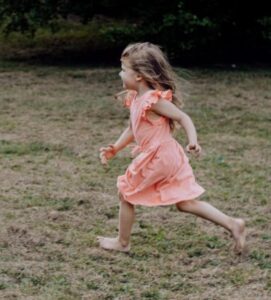
Final ThoughtsGirl running outside

Do you have older kids? For groups of children aged 4-10 I recommend the game: Farmer Farmer. It is similar to British Bulldog, but with a twist. 

What other no-prep outdoor games do you enjoy playing with your preschoolers?

Do your preschoolers still have energy? Great! Here are two other ideas to help you keep them moving:


A freshly cut onion with the title: Onion Layers


Examining Onion Layers

I glance at the clock. Time to start making supper. As I close my computer and head toward the kitchen, I decide that stroganoff would make a tasty meal tonight.

At the pantry, I reach for onions. Since this batch of onions was starting to go bad, I’m glad the bag is nearly finished. I make a mental note to put them on the shopping list.Red onions

Pulling out two onions, I glance at them. One is large and decently healthy looking. The other is small and covered in rot.

I place the cutting board on the counter and begin peeling the larger onion. That done, I locate my favourite knife and slice the onion in half.

I frown at what I see inside.

Although the large onion appeared healthy, the center has a rotting section. With a sigh I dissect it, discarding what’s bad.

I eye the smaller onion. If the onion that had appeared considerably healthier on the outside was rotten at the core, what chance did this miserable looking onion have of containing anything good at all?

Maybe I should just throw it out.

I glance at the pile on my cutting board of chopped good onion. It’s not as big as I want it to be for the meal. I could grab another onion from the bag and out-right discard the bad one. However, I wasn’t planning to shop for groceries for a few more days. With the onion bag so low, perhaps it was worth checking to see if the smaller onion had anything worth keeping.

Resigning myself to the unpleasant task, I gingerly reach for the smaller onion. I’ll give it a try.

I slice the onion open.

To my astonishment, the rot on this onion only went two or three layers deep. Once I peeled away the outside, I had a crisp juicy looking onion. Incredibly, the good parts of this onion looked far healthier than the good parts of the larger onion.

Chopped onion in bowlThe good part of the large healthy onion appeared fine and passable, but the good part of the small rotten onion appeared fresh and delicious.

I shake my head in wonderment. I’ve long known that onions go bad more or less in layers. Peel away the bad layers and you’ll likely find good usable onion within. This particular bag of onions, however, had thus far contained several onions that appeared mostly healthy on the outside, but had a bad section at their core. How amazing to find that the one onion that looked the worst was actually the best inside.

As I toss the chopped onions into the frying pan and turn on the heat, I find myself thinking about how people can have layers as well.

The Sunday School Lesson

Perhaps the most well-known verse to go with this thought is 1 Samuel 16:7b – a verse I memorized as a child.

“The Lord does not look at the things people look at. People look at the outward appearance, but the Lord looks at the heart.” (1 Samuel 16:7b NIV2011)

When did God say these words? God spoke them through His prophet Samuel when choosing a new king for the nation of Israel. God didn’t choose the strongest or the best looking. He chose David, a young shepherd boy at the time.

Here’s another translation of the verse: “Humans do not see what the Lord sees, for humans see what is visible, but the Lord sees the heart.” (1 Samuel 16:7b CSB)

Just like with the onions, I cannot see what is inside those around me, but God can.

If you grew up attending Sunday school, you’ve probably heard this principle many times. I know I have. It’s an important reminder from time to time, yet as I pondered the onion allegory, I wondered if there was something more for me to learn here.

A Further Onion Allegory

Then I recalled another passage of Scripture – a rather convicting one.

In Matthew 23, Jesus was pointing out the errors of the religious leaders of the day. He said:

“Woe to you, teachers of the law and Pharisees, you hypocrites! You clean the outside of the cup and dish, but inside they are full of greed and self-indulgence. Blind Pharisee! First clean the inside of the cup and dish, and then the outside also will be clean. … You are like whitewashed tombs, which look beautiful on the outside but on the inside are full of the bones of the dead and everything unclean. In the same way, on the outside you appear to people as righteous but on the inside you are full of hypocrisy and wickedness.” (Matthew 23:25-28 NIV2011)

For now, the lesson for me to consider has to do with my own core. What are my thoughts like and how do I behave when no one is there to see me? Am I rotten in these private unseen parts of my life?

It is so easy to do as the Pharisees did and focus on making the outside of my life look good.

Earlier in the same chapter, Jesus had said: “Everything they do is done for people to see.” (Matthew 23:5a NIV2011)

So how am I doing? Am I seeking God with all my heart or is it all for show? Am I giving Him room to work in the hidden areas of my life to be transforming me into His image? Or do I need to repent of selfishness and greed and hypocrisy and wickedness?

Will I be like the religious leaders who prompted Jesus’ cry at the end of Matthew 23?

“Jerusalem, Jerusalem, you who kill the prophets and stone those sent to you, how often I have longed to gather your children together, as a hen gathers her chicks under her wings, and you were not willing.” (Matthew 23:37 NIV2011)

Or do I pray as David did?

“Search me, O God, and know my heart!

Try me and know my thoughts!

And see if there be any grievous way in me,

and lead me in the way everlasting!”

(Psalm 139:23-24 ESV)


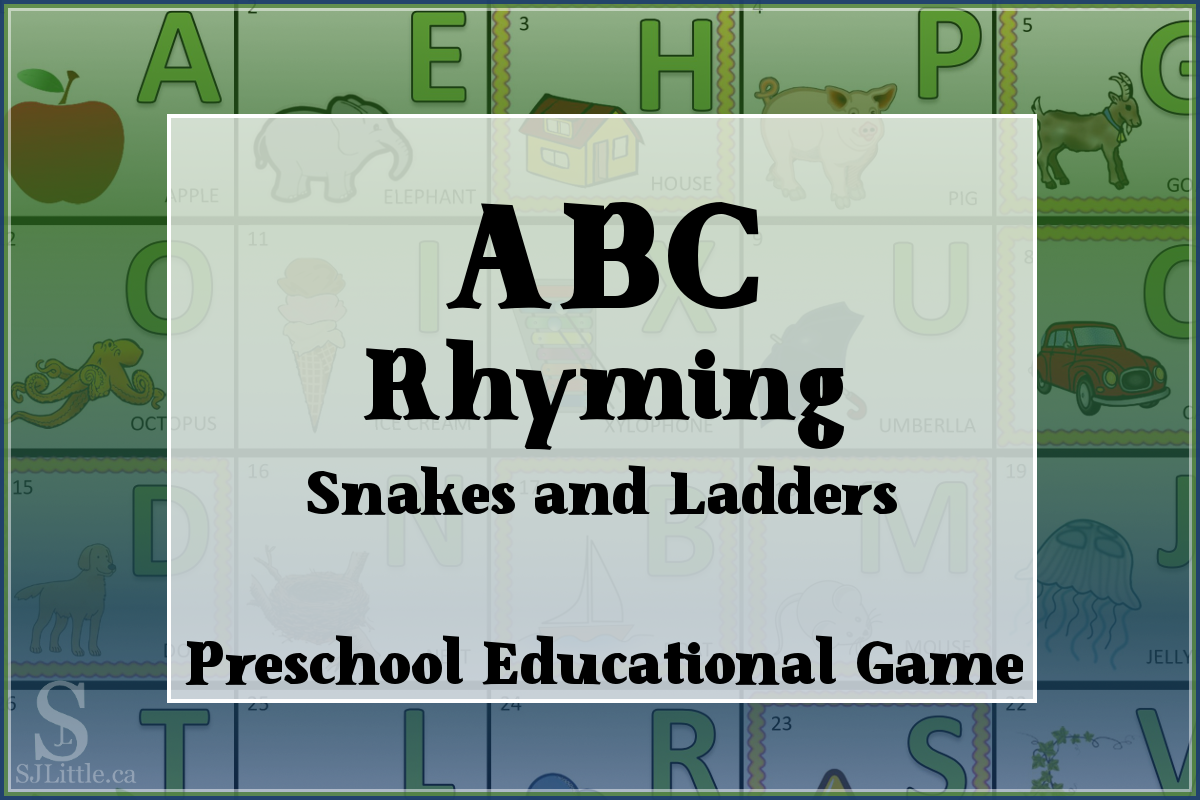
Looking for a game to play with your preschooler? Here’s a new one for you to print and enjoy together.

Are you familiar with the classic game Snakes and Ladders? If so, you are well on your way to knowing how to play this game. The primary difference is that, for this game, rather than having snakes and ladders, if a player lands on a yellow framed square, they move to the matching rhyme square. Confused? Don’t worry, I’ll explain.

What You Need

  • The ABC Rhyming Snakes and Ladders Game board printed out
    • Alternatively, open the image on a tablet or iPad and use that as your game board.
  • 1 six-sided die
  • 1 playing piece per person – I encourage you to use plastic pawns from a board game. Alternatively use very small toys, buttons, or even coins. (Beware of choking hazards.)

How to Play

  • Place everyone’s playing piece on the “START” square.

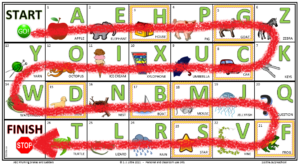
    Direction of play on the game board
  • Have the first person roll the die and move their playing piece accordingly.
    • For example, if they roll “4”, have the person move their playing piece to the fourth square which has the pig on it.
  • Players take turns rolling the die and moving their playing piece to the appropriate square.
    • Further details: Once everyone has had a turn to roll and move their playing piece, the first person gets to roll again. If the first person rolls a “5” on their second turn, they will continue counting from the fourth square with the pig on it until they reach the umbrella.
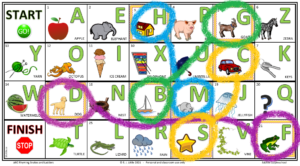
  • If a player lands on a square with a yellow frame around it, such as the boat, they move to the matching rhyme, in this case, the goat. Only squares with yellow frames have matching rhymes. The player moves to the corresponding rhyme regardless of whether they are moving forwards or backwards. (These moves are equivalent to snakes and ladders.)
  • The goal of the game is to reach the “FINISH” square first.

Educational Elements in ABC Rhyming Snakes and Ladders

Rhyming Matches
  • Rhyming – Listening to the distinct sounds in each word is a challenging skill for many children. It is also an important pre-reading skill. When playing this game with your child keep in mind that learning to rhyme is difficult for a 3 year old and may still be challenging for a 4-5 year old if they have not yet been taught about rhymes. Have patience as you model and teach the skill. Say the words slowly and emphasize the rhyming sounds. Once your child has a handle on rhyming, learning to read will be a little easier.
  • ABC Order – You may have noticed that the letters on this game board are not in alphabetical order. This is intentional. Children are incredibly smart. It is not uncommon for a child to memorize the letters in alphabetical order rather than learning to distinguish each letter by shape.  Mixing up the order of the letters gives an extra challenge and a chance for the parent to see how many letters their child can recognize by sight. I encourage you to take a moment to look at the letters on the board together.
  • Pictures – I have included a picture for each letter. These pictures serve as reminders for the child of what sound the letter makes. Sound out the name of the picture with your child to help them distinguish the sound of the letter at the beginning of the word. Grasping that each letter makes a sound and that those sounds can be combined into words will go a long way in preparing your child to start reading.
  • Counting / Turn-Taking / Waiting – These are three of the hidden developmental bonuses of playing a game like this. Every time your child rolls the die and moves their playing piece, they are practicing counting. Every time they have to wait for their turn, they are sharpening valuable social skills.

Like this free resource? Be sure to tell your friends about it and join my email list for access to other free printables.


Need To Move!

Preschool story by S. J. Little

Story entered in the Spring Fling Kidlit Contest 2021: https://ciaraoneal.weebly.com/spring-fling-kidlit-contest https://sites.google.com/view/springflingwritingcontest/main

Max word count: 150

Story word count: 150

GIF source: https://media.giphy.com/media/xTka04cLCQGJ1NsQbS/giphy.gif

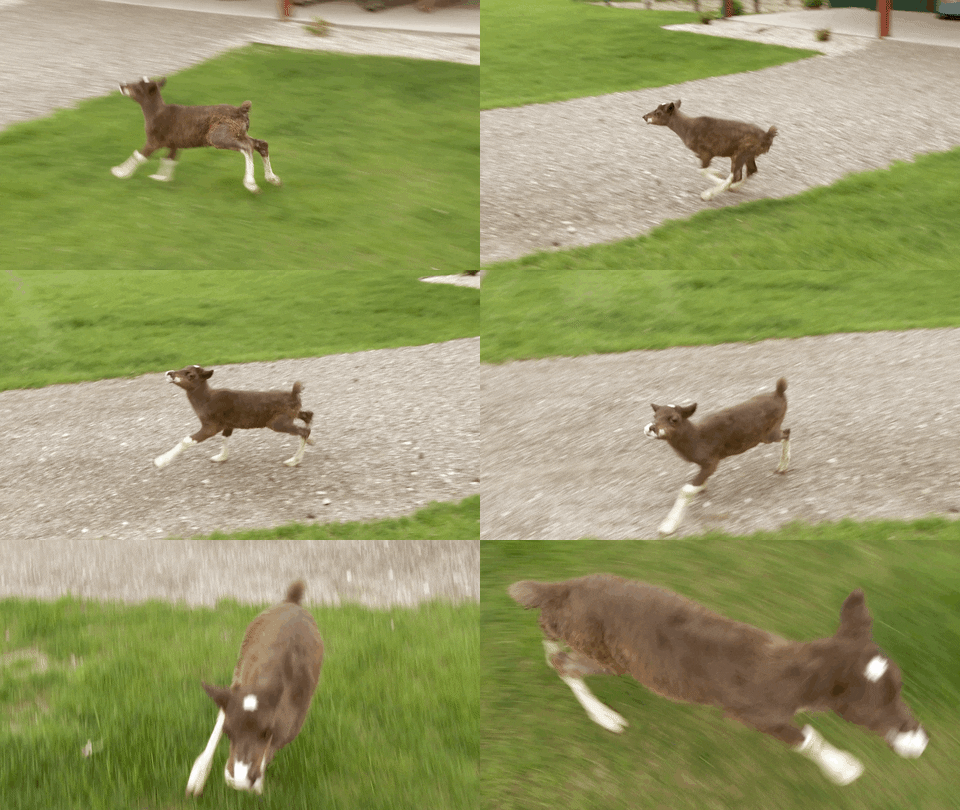
Robert the caribou calf yawned and opened his eyes.

As he rolled out of bed, he said, “Something is different.”

At breakfast, he asked for more grass.

“You’re hungry today!” his mother declared.

When he played with his trains, his tail began to twitch.

While watching cartoons, his ears began to swivel.

As he coloured a picture, his hooves began to fidget. He had to move!

“Mom, can I play outside?”

“Yes, you may.”

Robert dashed to the door and hurried out.

Warm sunshine touched his face. Grass peeked around decaying leaves where snow had been. Everything was turning green.

Robert galloped round and round.

He paused to smell the rich dirt as a worm wiggled through.

Hearing a melody, Robert looked up at the tree. “Welcome back, Mr. Robin!”

Sniffing the fresh air, Robert pranced through the yard.

Now he knew why he needed to move.

“Spring is here!”

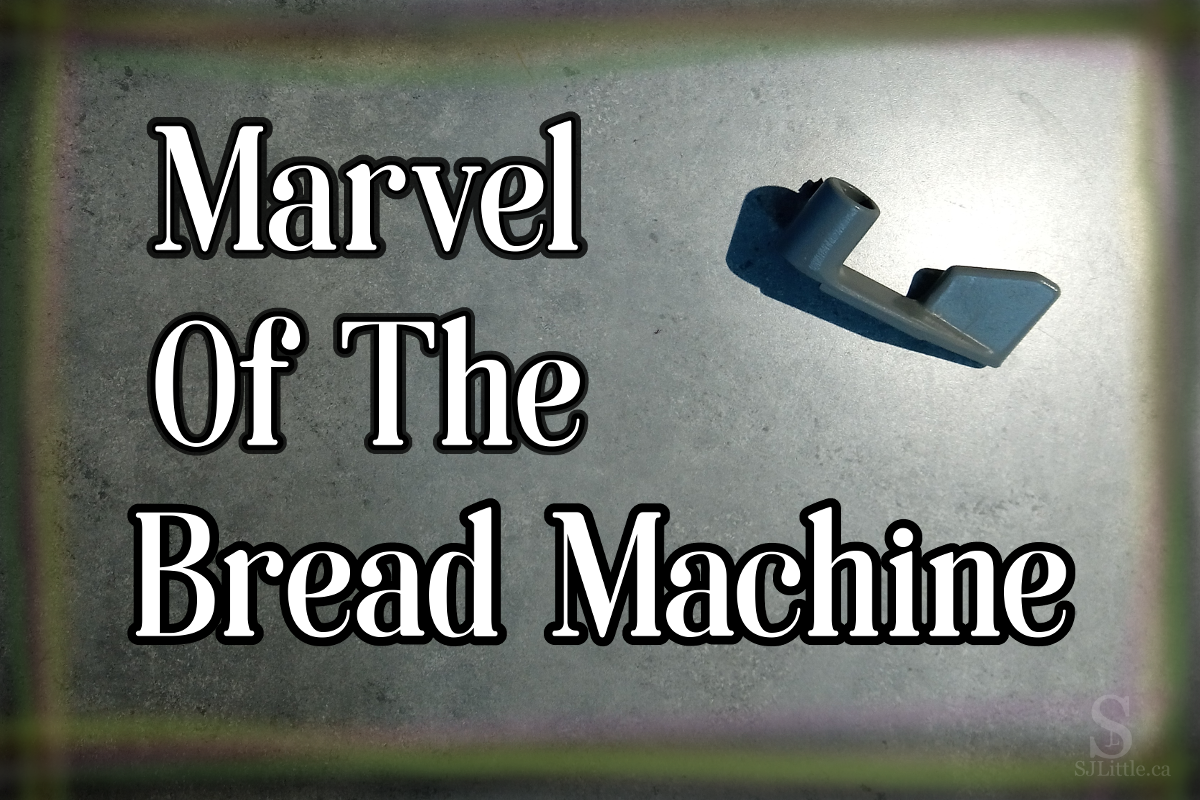
Picture of a bread machine paddle with title: "Marvel of the Bread Machine"


My Bread Machine

Recently, I was given a bread machine. I was thrilled to try it out.

Making homemade bread sounded appealing to me, especially when my favourite bread store closed. However, the thought of making bread by hand with all the kneading and learning the timing of waiting for it to rise, seemed daunting. It appeared to me a challenging art to be perfected, not to mention a workout.

This machine promised to handle all that for me. My job was to dump in the ingredients and push “start.” Its job was to magically turn those ingredients into a loaf of fresh bread.

I skimmed through several recipes before settling on one to do first. A basic whole wheat loaf.

I pulled out the ingredients. Yup, I had everything. I brought the bread pan to the table. Somehow I needed to attach that little paddle in the bottom. It took me a couple of tries before it slid into place. No screws or pins, just a little paddle sitting on a shaft. How would such a little thing be able to do the work that I, as a full-grown human being, found intimidating?Ingredients in a bread machine

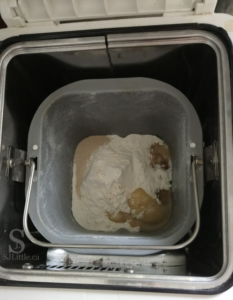
Well, apparently it would work, so I started measuring the ingredients. First the water, then the flour. Following that, the rest of the ingredients were dumped on top. I’d heard that it’s important to keep the yeast from touching the water and salt so I was careful to keep them separated.

That was it. All the ingredients were in. I re-checked the recipe to make sure I hadn’t missed anything. All good. Time to put the pan into the machine and figure out how to turn it on.

I closed the lid and plugged the machine in. Would it really turn such a small mound of ingredients into a full loaf of bread? There was only one way to find out.

I opened the manual and discovered that all I needed to do was press “Start”. So, I pushed the button. Right away I could hear the machine start working. It was rather noisy.

It pulsed and then whirled for a long time. Then it stopped and was silent. Again it whirled, then went silent. The indicator light told me which stage it was in: knead, first rise, second rise, and then bake. Finally, after a couple of hours, it reached the bake stage. The outside of the machine warmed up. I held my breath.

Just over four hours after I hit start, the machine beeped. I hurried to it!

It was done! I unplugged the machine and opened the lid. With oven mitts, I pulled out the pan and shook a golden fresh loaf onto the cooling rack.

There it was. I couldn’t help but marvel at it. Somehow that boxy machine and its little paddle had turned the ingredients into delicious fresh bread.

Living the Little Moments Well

As I pondered the marvel of the bread machine, I wondered what I could learn from it.

Perhaps one of the clearest allegories has to do with the impact I have on people’s lives. Whether it be children, family, neighbours, colleagues, or whoever else I have in my life, the little moments eventually add up to having a big impact.

That bread machine paddle was small – I could hold it in the palm of my hand. Yet, as it went around and around and around, it had a huge impact. Sometimes it just pulsed, sometimes it rotated to the right and sometimes to the left. Little by little, it mixed the dough just right. 

Sometimes I wonder if I need to be the next Billy Graham to tell people the Good News, or I feel like I have to be some super-neighbour.

The bread machine shows me that I don’t have to do something huge to impact others for great good. Rather, I need to live the little moments well.

What is it about the little moments that hold such value? Acting in love.

As Paul reminds us:

“If I speak in the tongues of men or of angels, but do not have love, I am only a resounding gong or a clanging cymbal. If I have the gift of prophecy and can fathom all mysteries and all knowledge, and if I have a faith that can move mountains, but do not have love, I am nothing. If I give all I possess to the poor and give over my body to hardship that I may boast, but do not have love, I gain nothing.” (1 Corinthians 13:1-3 NIV)

Indeed, Paul instructs us to: “seek to lead a quiet life, to mind your own business, and to work with your own hands, as we commanded you, so that you may behave properly in the presence of outsiders and not be dependent on anyone.” (1 Thessalonians 4:11-12 CSB)

I am to aim to live the little moments of life well rather than focusing on the big ones while neglecting the little ones.

The Order Matters

There is one more key to be mentioned. The bread maker gives a critical clue regarding how such little moments can have so large an impact. The order of things matters.

I have observed that every bread machine recipe starts with putting in the water and/or milk. While I have not been told such, I believe I can safely conclude that putting the flour in first would cause the machine great trouble.

What can I learn from this? Is there something that must always come first in my life? Indeed there is.

I am to love God first and foremost and seek Him above all else. (Matthew 22:37-38, Matthew 6:33) When I do so, every little rotation will have meaningful impact.

When I fail to put God first in my life, like failing to add water first in the bread machine, I will have great difficulty making anything worth keeping. In fact, I may totally break down because the pressure is too great and I cannot rotate at all.

Does leading a quiet life mean I should keep to myself and never be bold for Jesus? No.

Paul tells us:

“Look carefully then how you walk, not as unwise but as wise, making the best use of the time, because the days are evil. Therefore do not be foolish, but understand what the will of the Lord is. And do not get drunk with wine, for that is debauchery, but be filled with the Spirit, addressing one another in psalms and hymns and spiritual songs, singing and making melody to the Lord with your heart, giving thanks always and for everything to God the Father in the name of our Lord Jesus Christ, submitting to one another out of reverence for Christ.” (Ephesians 5:15-21 ESV)

Therefore, as I go about my day today, may I make it my goal to live wisely. What does that look like? It looks like putting God first and doing my best at what He has given me to do. Being intentional to do the little things well, with love. As the bread machine has shown me, that is how to have a big impact.

Interested in reading another allegory about the impact we leave on people’s lives? Check out The Time of Blossoms