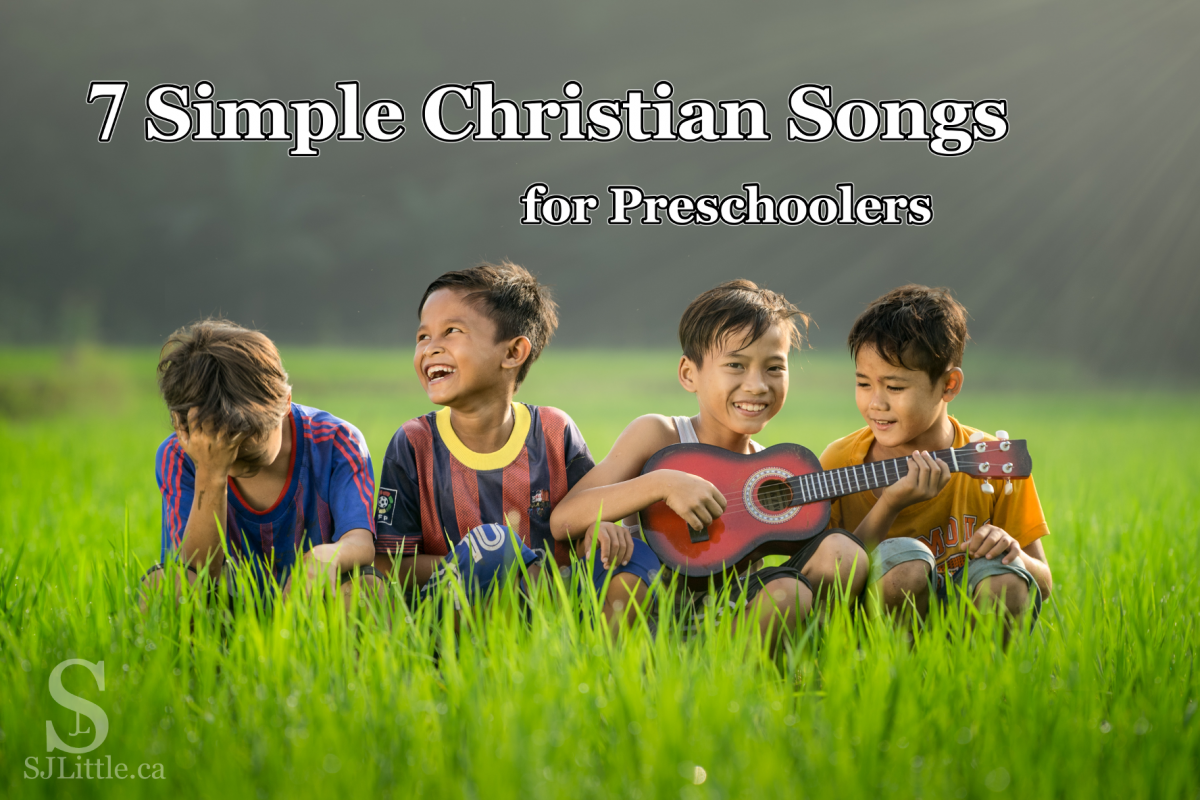
7 Simple Christian Songs for Preschoolers by S. J. Little - these songs instill timeless truths about who God is to help build a strong foundation for your child's faith.


Recently, I’ve had a couple of people ask me about simple Christian songs to sing with preschoolers. Songs that don’t need a CD player, or a major in music, to sing.7 Simple Christian Songs for Preschoolers - Read Your Bible Pray Every Day - S. J. Little

Having taught Sunday school for many years and having been a teacher at two Christian preschools, I have gathered a number of solid Christian songs with great actions for engaging children.

These songs work excellent for transitions, such as moving from play time to story time, or if your children have to wait. Children 1-6 years old are likely to appreciate these songs. Some of them are best sung standing up, providing an opportunity to get some wiggles out, while others help calm and settle the class.

Beyond that, these songs are excellent teaching tools for hiding timeless truths in children’s hearts. While I don’t remember the stories I was taught in Sunday school when I was 4, I still remember the songs, several of which are on this list.

Please note: The sample videos I have included were chosen for the clarity of the song and actions. I am not associated with any of them and have not done extensive research into the groups who posted them. Also, while I tried to find videos similar to how I prefer to sing these songs, some actions and/or words may vary from the versions I have recommended for you.


1. Read Your Bible, Pray Every Day

(Tune: I Will Make You Fishers of Men)

By: Harry D. Clarke

A great energy outlet song. Children stand up and crouch down and stretch super high! While there are other verses for this song, I prefer to only use the words I have included below and then sing the song again faster, and faster!


Read your Bible, pray every day,

Pray every day, pray every day.

Read your Bible, pray every day,

And you’ll grow, grow, grow,

And you’ll grow, grow, grow,

And you’ll grow, grow, grow,

Read your Bible, pray every day,

And you’ll grow, grow, grow,

Actions:

Read your Bible – Hold hands together, then open like book

Pray every day – clasp hands in praying posture

Grow – Start very low, then become a little taller each time you say “grow”. For the last time you say “grow” stretch on tippy toes with arms extended above head.

2. Happy All The Time (In-right, Out-right)

By: Anonymous (before 1942)

Another excellent stand up song. I heard this song in grade 10, when helping with a kid’s program, and knew I’d heard it before. I finally remembered I’d learned it in Sunday school when I was 4 years old. It was one of my favourites.


I’m in-right, out-right, up-right, down-right,

Happy all the time.

I’m in-right, out-right, up-right, down-right,

Happy all the time.

Since Jesus Christ came in, and cleansed my heart from sin,

I’m in-right, out-right, up-right, down-right,

Happy all the time.

Actions:

In-right, out-right, up-right, down-right – Point in each direction as you say it.

Happy all the time – Clap on every other beat (happy all the time)

Jesus Christ came in – Point to sky, then point to self

Cleansed my heart from sin – motion with both hands as though swatting something away

3. My God is so Big

By: Cedarmont Kids (1993)

This classic song includes simple truths children can begin to grasp, yet such profound truths that even as an adult I cannot fully wrap my mind around them. Depending on how you sing it, this song can be an active, shake-some-wiggles-out song or a quieter sit down song.


My God is so big, so strong and so mighty,

There’s nothing my God cannot do.

My God is so big, so strong and so mighty,

There’s nothing my God cannot do.


The mountains are His, the rivers are His,

The stars are His handy work too.


My God is so big, so strong and so mighty,

There’s nothing my God cannot do.

(optional) For you!

Actions:

God – point up

Big – spread arms wide (optional: do a star jump, then jump back in when doing “strong”)

Strong – make muscles with both arms up

Mighty – make muscles with one arm up and one arm down

Nothing my God cannot do – wag finger to say “no”

Mountains – touch fingers together above head making triangular point

Rivers – move hands back and forth wiggling fingers

Stars – alternate opening and closing hands

For you – point to someone

4. God Made Me

Traditional

I saw another preschool teacher using this song and enjoyed it so much I wanted to do it with my own class. This is a quieter song with powerful truths simply told.


God made me, God made me,

In my Bible book, it says that,

God made me.


God loves me, God loves me,

In my Bible book, it says that,

God loves me.


Other verses:

God helps me

God keeps me

Actions:

God – point up

Me – point to self

Bible – hold hands together and open like a book

Made – stack fists on top of each other (resembling sign language “make”)

Loves – make heart with hands

Helps –  cup hands as though receiving something

Keeps – hug self

5. He’s Got the Whole World in His Hands

Traditional African-American Spiritual (before 1927)

Another timeless classic. What a beautiful reminder that God is in control. Pick and choose which verses you want to use, or make up your own.


He’s got the whole world in His hands,

He’s got the whole world in His hands,

He’s got the whole world in His hands,

He’s got the whole world in His hands.


He’s got the itty bitty baby in His hands,

He’s got the itty bitty baby in His hands,

He’s got the itty bitty baby in His hands,

He’s got the whole world in His hands.

Actions:

Whole World – start with both hands at top, bring down tracing a large circle

In His hands – cup hands in front of self

Itty bitty baby – pretend to hold baby and rock from side to side


There are endless other verses including:

The wind and the rain… (Sweep hands from side to side, then move hands up and wiggle fingers while moving hands down)

The sun and the moon…   (hold arms above head in circle, then twist arms into crescent)

You and me, brother…   (point to boys)

You and me, sister…   (point to girls)

The Mommies and the Daddies…   (point to parents)

Everybody here…  (motion to everyone)

6. The B-I-B-L-E

By: Anonymous (before 1924)

One teacher I knew always sang this song with the kids before reading a Bible story. It showed that this isn’t just another storybook.


The B-I-B-L-E, yes that’s the book for me.

I stand alone on the Word of God,

The B-I-B-L-E

Bible!

Actions:

B-I-B-L-E – open hands like book (could also nod the beat)

Yes – nod head and do sign language “yes”

For me – point to self

I stand alone on the Word of God – stomp

7. I’m in the Lord’s Army

Traditional (before 1947)

Little boys love this action song, as do little girls. I remember this being one of my favourites when I was young. I encourage you to explain to your children what it means to be in the Lord’s army. Our life has purpose.


7 Simple Christian Songs for Preschoolers - I'm in the Lord's Army - S. J. Little

I may never march in the Infantry,

Ride in the cavalry,

Shoot the artillery.

I may never fly o’er the enemy,  

But I’m in the Lord’s Army. Yes, sir!


I’m in the Lord’s Army. Yes, sir!

I’m in the Lord’s Army. Yes, sir!


I may never march in the Infantry,

Ride in the cavalry,

Shoot the artillery.

I may never fly o’er the enemy,

But I’m in the Lord’s Army. Yes, sir!

Actions:

March – march in place

Ride – pretend to ride a horse

Shoot – start with one hand at hip and other up high, clap, put hands in opposite positions

Fly – move arms wide and lean side to side as though flying

I’m – point to self

Lord’s army – point up

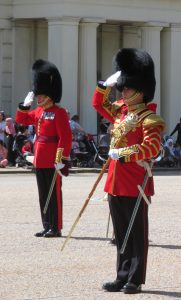
Yes, sir! – stand straight and salute


If you doubt whether kids enjoy this sing, watch this cute video.

Bonus:

He Died Upon the Cross

By: Colin Buchanan

This is one of my favourite preschool kids songs, however, it doesn’t sound as good without instruments. Thankfully the song can be bought online as an mp3 file. I highly recommend you buy it and sing it with your children as this song captures the very core of Christianity as seen in 1 Cor. 1:3-4.

The song is available for purchase here (you can choose to only purchase this song #33, or buy the whole CD) https://colinbuchanan.com.au/products/practise-being-godly-cd-mp3-album  (Note: prices on website are in Australian dollars. This is not an affiliate link, I just like the song so much!)


He died upon the cross.

He died upon the cross.

He died upon the cross,

For me, for me, for just for me.


One day when I was lost,

He died upon the cross.

He died upon the cross,

For me, for me, for just for me.


Additional verses: (Repeat “One day when I was lost” chorus after every verse)

They laid Him in the grave.

He rose up from the dead.

He’s coming back again.

Actions:

For – hold up four fingers

Me – point to self

Just – (optional for older kids) make “j” with pointer finger and thumb

One day when I was lost – point to self, then tilt head back and put back of hand to forehead as though tired and hopeless

He died upon the cross – point up, then spread arms wide like the cross and let head hang forward

They laid Him in the grave – move both arms downward as though laying something down

He rose up from the dead – move arms upward with hands outstretched

He’s coming back again – motion as though for someone to come closer

7 Simple Christian Songs for Preschoolers - My God is so Big! - S. J. LittleDid you enjoy these 7 Simple Christian Songs for Preschoolers? If so, be sure to check out the follow up post titled “Another 7 Simple Christian Songs for Preschoolers.

Ever struggled to wash paint off a child’s hands, or sent chalk-covered children home? Ever had someone complain because your children used chalk where someone else didn’t want it? I have.

Outdoor painting with water can eliminate all that.

Water painting. Fun alternative to chalk. Read more at SJLittle.caSupplies Needed:

  • Container to hold water (i.e. bucket)
  • Water
  • Old paintbrush or alternative
  • A sidewalk, fence, deck, etc.

Prep 

It’s simple, really. Dress your children for the weather. Put a inch or two of water in your container and hand your child a paintbrush.

How It Works

When the wet paintbrush touches the concrete sidewalk, or other surface you choose to paint on, it leaves a wet mark creating the illusion of being painted.

Your children can paint and paint to their heart’s content and while they do so, their older paintings will gradually dry up giving them room to create still more paintings. In this way, the painting fun is never-ending for they never run out of space. When they are done and head inside, all their paintings will dry up leaving no mess behind. (Not that I think children’s chalk pictures are a mess, but I’ve been in settings where our outdoor play area was shared with others who complained about the drawings.)

Note, some children will dump the water, perhaps on themselves. Therefore, you could end up with wet children which is not a bad thing on a hot day.

Benefits

  • Low cost – once you have your bucket and paint brushes you are good to go. No more buying chalk
  • Low mess – your children may become wet, but they will not be covered with chalk or paint
  • Low prep – fill the bucket, dress your children for outside and you are set
  • Low clean up – the paintings dry up leaving no trace behind

Don’t Have Paintbrushes?

If you don’t have paintbrushes, or none that you want to use outside, try finding an alternative such as a small piece of sponge or a pompom. Adding a clothespin as a handle could help protect little fingers from scraping against the sidewalk when using such small painting tools.

What About Chalk?

Am I discouraging the use of chalk? No. I use chalk with my children often. However, if leaving chalk pictures behind or having chalk-covered children concerns you, this is a handy alternative.

Water painting. Fun alternative to chalk. Read more at SJLittle.ca

 Also, if you use chalk often, switching it up with painting with water will create renewed interest due to the novelty of the activity.

What are you waiting for? Grab a bucket, a brush and a child and go have fun!

Boys running outside

When running in circles is a very good thing for children…

Ah, spring is in the air. That lovely time of year when grass turns green and flowers begin to bloom. I love this time of year for so many reasons.

Unfortunately, this season also gets into the children. Teaching circle time becomes far more challenging than before. The children become extra antsy, wiggly, and sometimes more irritable.

I am writing this article in the spring because this is when children need more time to run. At the same time, I highly recommend increasing the amount of running throughout the year, as many children today spend far too much time sitting.

The Running in Circles Strategy

What’s the strategy? It’s very simple really. Let your children run in circles. Not only that, but encourage them to do so.

Let me explain.

The vast majority of preschool schedules include a segment of time for gross-motor play, such as running and jumping. Most preschools call this gym time.

Different teachers handle this time differently based on their children, space, and the materials available to them. Some teachers put out a variety of toys from balls to tricycles and consider gym time as free play. Others plan structured games, such as Red Light/Green Light, for the entire length of gym time. Still other teachers will go halfway in between with some structured time and some free play.

I have worked with teachers who do gym time in all three ways. Letting children run in circles can be done in any type of gym time.


Why Circles?

Two children running fast

By running in circles rather than to a wall and back, the children can run at their own pace. Faster children might run 5 laps while slower children may only run 2 laps. No one has to wait for the slower ones to catch up, and everyone has fun together.


What it Looks Like

How does this look in my gym class? I’m glad you asked.

As the children arrive in the room used for gym, I have them stand (or sit) in a particular place. Typically, I use a wall or a line on the floor for them to stand along. Always beginning gym time this way eliminates a large amount of chaos, which can come from transitions.

Once everyone is lined up, I like to do some sort of warm-up whether stretches or singing a standing up song, such as Head and Shoulders.

That done, I tell the children to run in circles around the room.

The first few weeks I find it helpful for me to run with the children, modelling one large circular track around the room. I make sure I’m excited about it and encourage them to join me. As they become accustomed to this, I can simply encourage them to run, while I stand in the middle. However, I don’t stay standing long. To increase their endurance more, I wait until they start losing steam, then I join them by running in circles too. This typically spurs the children on for another lap or two.


Benefits

What is the point of this strategy?

I have seen two tangible results in my classes.

First, the children’s endurance improves. One class of two and a half year olds, whom I implemented this strategy with, noticeably improved their endurance in a couple months of running in circles once a week. They also appeared to greatly enjoy running after the first few weeks.

Second, in running those laps, the children burn through some of their hugely abundant energy and then are more ready to play structured games such as Red Light/Green Light.

Those are just from my observations. Many studies and personal testimonies exist about the benefits of physical exercise for children, such as the following links:

The Daily Mile – Scotland school fights obesity with exercise https://www.youtube.com/watch?v=XtxuwC6lbQQ

Active Kids, Active Minds | Kathleen Tullie | TEDxNatick https://www.youtube.com/watch?v=HsyHmLPApPI


Aren’t Standard Games Enough?

Various structured games do get the children moving which is excellent. I, however, still like to have the children run in circles prior to playing structured games. This helps them focus on following the instructions later. Also, the children who struggle most to follow the dos and don’ts of a structured game are often the very children who need to run the most. Running in circles is easy and doesn’t require following complicated instructions. Besides this, many structured games do not keep the children at a high level of physical activity the same way simply running does.


Running in Circles at Home

Parents, did you know there are many ways of encouraging your children to run in circles at home too?Mom and Girl Running

You can take them to the back yard and encourage them to run laps around it. For older children, you can have them run around the outside of the house.

If you have a house like the one I grew up in, you may have a circular path in your house that can be used for running on days too cold to go outside.

Motivation can be tricky when it comes to encouraging your child to run at home. Your child will likely enjoy it more if you or another child runs with them. If you aren’t able to run with them, for older children, you could try timing them. How long does it take to run 5 times around the yard? Can they do it faster tomorrow?


Conclusion

We often hear how important physical activity is, but can find it tricky to include in our children’s day. Thankfully, it doesn’t have to be complicated. It can be as easy as running in circles.

Looking for easy active games for your child? Try these:

Teaching ABCs by S. J. Little with picture of alphabet puzzle

With spring comes wiggly children. Keeping the attention of a class full of preschoolers this time of year is challenging. Sometimes changing up your methods for teaching the ABCs can regain their enthusiasm for learning letters.

Below I have collected 9 unique techniques for teaching the ABCs at circle time.

For more tips, check out my article: 8 Tips for Keeping Preschoolers Engaged During Circle Time

  1. Letter posters

Many teachers use a set of posters with one poster per letter. Typically these include the letter and pictures of one or more items starting with that letter. Each week the poster for the letter of that week will be displayed. Then during circle time the teacher points to the poster and asks the children if anyone knows what letter it is and what the objects are.

  1. Singing

Many songs exist for helping children learn about letters. One that I’ve used is:

Letter “A” Says a
Tune: Farmer in the Dell


Letter “A” says a,

Letter “A” says a,

Every letter makes a sound,

Letter “A” says a.

If you use the same song every week the children will be able to focus on the letter and sound rather than the tune of the song, however, changing it up may keep their attention better.

  1. Air tracing

For children who learn best through large body movements, this technique is wonderful. As you tell the class the letter, use your whole arm to trace the letter in the air in front of you. Encourage the children to copy you. You could also have them trace it in the ground with their finger (or foot). Alternatively, have them shape their whole body into the letter. For example, for letter t they can stand straight with their arms perpendicular to their sides. Get creative and have some fun.

  1. Letter box

Items to put in a letter box for letter "P" - pig, police, pencil, pineapple, pink heart, purple P

Prior to class fill a small box with four or five items beginning with the letter of the week. Look through your toy bins, puzzles and playdough cookie cutters. I also like to include the letter itself whether on a puzzle piece, or block, or magnet.

At circle time, I show the children the box and have them chant with me while tapping the beat:

Open up the box

Open up the box

Open, open, open, open

Open up the box.

I then bring out one item at a time, asking if they know what each is and discussing how each relates to the letter. This adds excitement and mystery to learning about the letter.

  1. Mystery item

A little different from the letter box, this activity works best when at least a handful of children in the class already have a good sense of the alphabet.

Toy dog peeking out of boxPrior to class, find an item starting with the letter of the week. Place that item in a box as the mystery item. Show the children the box telling them that something is hiding inside it. Inform them that the item starts with the letter of the week. Review with them what sound the letter makes.

Ask the children to guess what item may be inside the box. Be gentle and encouraging with those who guess items starting with the wrong sound, otherwise, they may not be willing to guess next time. For any guesses that are the right sound, you could answer, “maybe…” Then ask for a few more guesses before revealing the item.

  1. Popsicle stick letters

This is another good one for hands-on learners, however, this technique only works with certain letters.

When the letter of the week is one with no curves, you could try this technique. Prior to class, determine how many popsicle sticks you will need to make the letter. Also, ensure you have enough for every child to make their own letter.

At circle time, use the sticks to show the children how to make the letter.Popsicle sticks can be used to form letters Then hand out enough popsicle sticks to every child. (You could make this a game by handing too many or too few sticks to some of the children and having them count to tell you if they have the wrong number.)

Once every child has the correct number of sticks, show them again how to form the letter by placing the popsicle sticks on the ground in the correct shape.

Be encouraging as this is very tricky for children the first few times they do it. You may have to show several of them one on one. You could also encourage more advanced children to help those who are struggling. Once you’ve done this a few times the children will catch on better.

  1. Draw on a whiteboard/chalkboard

Another hands-on way to learn letters and develop writing skills is to have each child write the letter at circle time. This can be done one at a time or all at once depending on the materials available to you.

One at a time:

On the bulletin board, securely attach a larger writing surface whether a chalkboard, whiteboard, or large laminated poster to be used as a whiteboard.

One at a time, invite each child to come up and try writing the letter of the week on the board. Be sure to write it first so they have something to copy. Be encouraging as not only are they being courageous to try writing the letter, they are also practicing being comfortable in front of a crowd which does not come easily for some children.The letters ABC written on a whiteboard

All at once:

Pass out individual whiteboards or chalkboards to each child. On your own whiteboard or chalkboard demonstrate writing the letter, then encourage each child to try it on their boards. Some children may need one on one help with this.

  1. While taking attendance

Some teachers take attendance during circle time by calling the children one at a time. Rather than just having the children say “here” why not use this time to help them learn their letter?

Before taking attendance, discuss the letter of the week with the children and mention some things that start with that letter.

Next, instruct the children that when you call their name, you want them to say something that starts with the letter of the week. Ideally, have some visual reminder of words starting with that letter. Most likely several of the children will say the same thing. That’s okay.

  1. Alphabet Videos

Something I have not tried but believe could work well is using videos. Youtube has a wide range of short films, often including songs, about learning letters. These could be integrated into the circle time routine.

What other strategies have you found effective for teaching the ABCs at circle time?

Looking to make a curriculum to fit your children’s needs? Here’s some advice you don’t want to miss: Create Your Own Preschool Curriculum for Free

Girl holding paintbrush


13 Simple and Inexpensive Ways to Engage Children with Paint and Paper

Perhaps you have some washable paint laying around, but want to change things up. There are many fun alternatives to paintbrushes. Several of them have valuable developmental bonuses for your child beyond merely strengthening creativity.


Basic tools to use instead of paintbrushes:

  1. Fingers    (All ages)Finger Painting - S. J. Little

    • Messy and delightful for most children, simply allowing your child the freedom to finger paint is an excellent sensory experience.
    • Some children dislike the sensation of paint on their fingers. If that is your child, try modelling by doing some finger painting of your own. Reassure them that you’ll help them wash their hands after. If they still resist, don’t push them. Rather, work your way toward it by giving them tools such as sponges where their fingers will likely get a little paint on them, but not as much as with finger painting.
  2. Sponges    (All ages)

    • A straightforward painting experience. Gives the child an opportunity to experiment with gentle and firm pressure.
    • Take an unused sponge and cut it into easy to hold sizes. Rectangles, roughly 8cm tall and 4cm by 4cm on the ends, work well for small hands. Alternatively, if you want to get really creative, you can cut the sponge into shapes such as trees, hearts, or fish.
    • Expect sponge painting to be messy. Only put small amounts of paint for the child to dip the sponge in, as they can easily get an excessive amount of paint.
    • Sponge painting works well with stencils.
  3. Cotton swabs/Q-tips®    (2.5 years+)

    • A personal favourite of mine. The small size of cotton swabs helps exercise the child’s fine motor muscles – the hand muscles used for holding a pencil among many other things. Cotton swabs allow the children to paint dots or small lines – far more detailed than most kids’ paintbrushes. I find the Q-tips® brand works well.
    • Some 2 year olds may find cotton swabs too small to grasp easily and thus may not enjoy using them. Therefore, I recommend them for children 2.5 years old and up.
    • Because cotton swabs are small, it takes more time for the child to fill the page, which encourages them to focus longer than with a large paintbrush. With this in mind, it may be wise to use only half a sheet of paper when working with cotton swabs to make filling the page more attainable.
    • Depending on the child, painting with cotton swabs can be relatively clean.
  4. Yarn    (2.5 years+)

    • Children can create beautiful works of modern art when painting withYarn Painting Sample - S. J. Little a short piece of yarn, and they enjoy doing it. While they’re at it, they will be strengthening their arm muscles by the abundance of up and down and side to side movements.
    • Cut yarn into pieces roughly 8cm in length. I like to have one piece of yarn per colour of paint. Inevitably a few strings will be dropped into the paint leaving them entirely paint saturated. Therefore, I try to have extra strings cut and ready to use for such emergencies.  
    • I recommend using a shallow dish to hold the paint for easy dipping. To start, it may help to use a finger to submerge one end of the yarn into the paint.
    • This yarn painting can get messy. The finished products, however, typically look attractive.
  5. Fork    (3.5 years+)

    • For a unique challenge, hand the child a plastic fork and a shallow dish of paint. Fun picture ideas could be a flower, a chick, or grass. This experience strengthens hand-eye coordination. Problem-solving is also required if trying to paint a specific object.
    • Keeping the paper small is advised as children may not have the attention span needed to fill a whole page.
  6. Toothbrush    (4 years+)

    • Want a major fine motor muscle strengthener? Bring out the toothbrush and prepare for a fun, messy time!
    • Toothbrush painting only takes a small amount of paint, but it may be helpful to add a drop of water to the paint. Cover the table and surrounding area or be prepared to wipe it as it will get messy.
    • Encourage the child to hold the toothbrushExample of how to use a toothbrush to make a painting with its bristles facing the paper. Show them how to run their thumb (or finger from the other hand) through the bristles causing the brush to spray droplets of paint onto the paper.
    • Expect most children to have a short attention span for this activity as their hand muscles will likely tire quickly – evidence that it is good exercise for those fine motor muscles.


Things to dip in paint:

Be aware that toys with metal parts may rust if exposed to water when cleaning paint off of them. Also, it may not be possible to get all the paint off whatever items you use, therefore, pick carefully.

  1. Jar/bottle lids    (2.5 years+)

    • Wash and save various bottle and jar lids, then pour paint on a plate and let your child use the lids as stamps. They might make a snowman, a flower, or a lovely modern art pattern. Their fine motor muscles will be strengthened by the various grips required to hold the lids.
    • If your child is prone to putting items in his/her mouth, beware that small lids may be choking hazards.
    • This can get messy and lids can become slippery when paint-covered and thus may fall on the floor. Therefore, if you are working over carpet you may want to cover the floor.
  2. Dinosaurs    (2 years+)

    • Choose some large washable dinosaurs (the smoother their skin the easier to clean – avoid those with metal). Encourage your child to “walk” the dinosaurs through a plate of paint and across their paper leaving dinosaur footprints. The dinosaurs have a fair amount of weight which, combined with all those up and down movements, will strengthen important arm muscles.
    • Children love this activity! However, I caution against using this “dip your toys in paint” idea with young children who do not yet grasp the concept that only certain toys are okay in paint at certain times. The last thing we want is their teddy doing a faceplant in the paint dish.
  3. Cars    (2 years+)

    • If you have some primarily plastic cars with no internal mechanisms which may be damaged by water, this activity can be tremendously thrilling! What’s the developmental value of it? If you give the child an extra large piece of paper to drive their car across, they will likely make many large, full-arm movements using muscles needed for writing. These types of large arm movements are especially important for development in 2-3 year olds.
    • Pour the paint onto a plate and encourage the children to drive the cars back and forth in the paint to coat the wheels before driving the cars around on the paper.Car Track Painting - S. J. Little
    • If you have the option, this is a good activity to cover the entire table with paper for the cars to leave tracks on.
    • As with the dinosaurs above, I caution against doing this with young children who may not yet realize that this does not give them permission to drive the cars through any other sticky paste they can find.


Paper

Changing up the paper is another way to keep painting fresh and exciting.

  1. Size

    • Change up the size of paper you give your child.
      • If they are painting with something small, have only a short amount of time, or have a short attention span, use a small piece of paper.
      • If they enjoy painting, have plenty of time, or are using a large tool, use a full-size piece of paper.
      • Using bigger papers can encourage healthy arm muscle development as they reach to paint on the far edge of the paper.
  2. Shape

    • Before it’s time to paint, cut the paper into a simple shape such as a triangle, heart, circle, or fish. Then allow the child to paint however they want.
  3. Whole table

    • On occasion, covering the whole table with paper and allowing several children to paint on it at once can be a fun change. The children often enjoy being able to paint long lines without running into the edge of the paper. On top of that, having several children painting on the same surface gives a social development aspect to painting.
  4. Colouring sheets

    • Some painting techniques work well on colouring pages. Younger children could use sponges, while older children could use cotton swabs which allow them to paint inside the lines.


        Have fun painting!

What are your favourite paintbrush alternatives for preschool painting?